Bangalore’s charm as a Garden City may have diminished. However, some of the trees that perhaps earned its name are still to be seen and cherished. For those of us who would want to simply immerse ourselves in that moment appreciating the beauty of each of these flowering trees that dot Bangalore it really does not matter …we will continue to do so. For those who would want to know more information about these trees, I have tried to put together some information and pictures for 26 species that are often seen. Eventually, I hope to add more species to this list. Hope you find it useful.
Here is a review of the book ‘Discover Avenue Trees’ that appeared in Bangalore TimeOut – www.timeoutbengaluru.net/bangalore-beat/features/trunk-call
(Updated)Click here to download the PDF
Gliricidia sepium
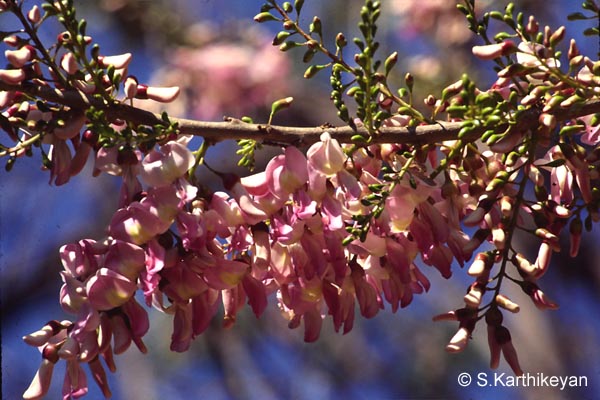
Common Name : Gliricidia, Mother of Cocoa, Quick stick (Jamaica)
Origin : Pacific coast of Mexico and Central America
Flowering Season :February-April
Vernacular Name : Gobbarada mara
Brief Description : A small, deciduous, ornamental tree, planted in gardens and fields as a green manure tree. The tree is leafless when in flower and bears fruits during April and May. The small flowers (barely 2cm long) are pale pink and they are borne in dense clusters on bare twigs. Flowers fade to white / faint purple with age. It can be used as an ornamental. The flowers attract a lot of bees and some lycaenid (Blues-Family Lycaenidae) butterflies – particularly the Peablue Lampides boeticus. There are several of these trees in Lalbagh, Cubbon Park, other gardens and a few along roadsides.
Castanospermum australe
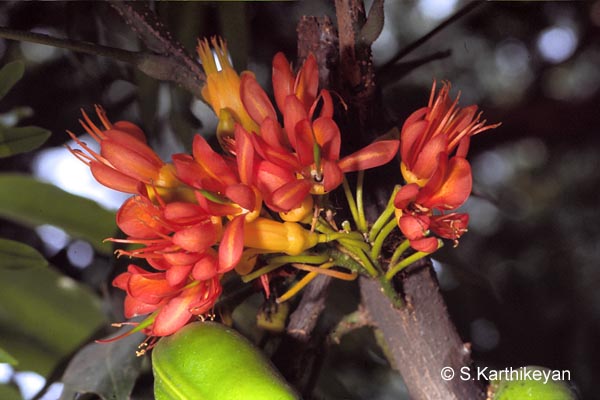
Common Name : Black Bean or the Moreton Bay Chestnut
Origin : Coastal rainforests and beaches in Australia
Flowering Season :February-March
Vernacular Name : None
Brief Description: This is a handsome tree with glossy dark green leaves and low spreading branches when grown in the open. It bears sprays of red and yellow pea-shaped flowers (about 3 to 4 cm long), which are partly hidden by the dense foliage. The nectar produced by the flowers attracts birds, bats and butterflies in its native land. Large woody pods (measuring 12-20cm by 4-6 cm) are produced following flowering. The pods look like large groundnuts. These pods split in two, revealing 2-4 large bean like seeds. The tree is known to contain alkaloids that have been shown to have anti-HIV and anti-cancer properties.
It is an ideal shade tree in parks, resorts and gardens. It is known to have a strong root system, which can be used to consolidate stream banks against erosion.
There are several of these trees in Cubbon Park (the road leading into Cubbon Park opposite old Tiffanys), near the High Court (near the statue of Sir Mark Cubbon), Lalbagh, her gardens and a few along roadsides.
Peltophorum pterocarpum
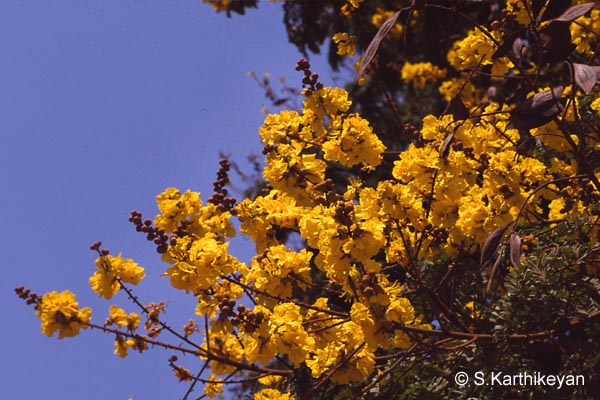
Common Name :Copper Pod
Origin :Ceylon, Andamans, Malaya and North Australia
Flowering Season :March – September
Vernacular Name :Haladi Gulmohur
Brief Description: The Copper Pod is considered to be a semi-evergreen tree. It is seldom leafless though it sheds leaves en masse during the winter months for a very brief period. The name `Copper Pod’ comes from the coppery-red seed cases that are seen in profusion (they turn black with age).
A species which is easy to propagate, hardy, and can survive in harsh conditions. A pretty sight when in bloom. It bears clusters of yellow flowers at the end of the branches, together with dark green leaves. The ground under the tree is strewn with a carpet of the yellow petals and is sight to behold. The tree is large and very shapely.
These trees are in the park flanking Nanda Road (continuation of RV road) from South End to Jayanagar and several other areas of Bangalore.
Bombax malabaricum
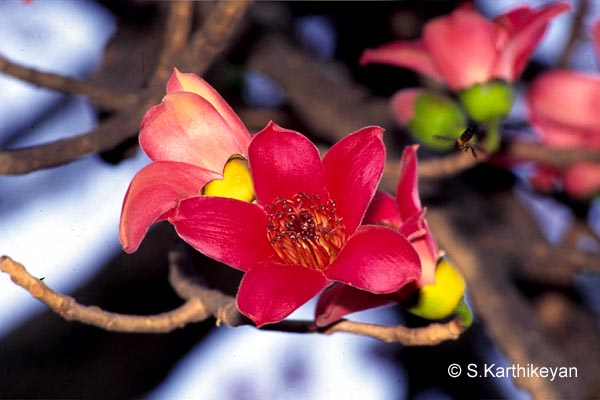
Common Name :Red Silk Cotton
Origin :India and Malaya
Flowering Season :January – March
Vernacular Name :Booruga (Kannada)
Brief Description:The tree is a blaze of colour and completely leafless when in bloom. The numerous, large, cup-shaped, crimson flowers are very attractive. The flowers attract a variety of birds and there is a cacophony of bird calls. Depending on where the tree grows the birds that visit the flowers also vary. Soon after, large green fruits dangle from the tree which turn brown ejecting the soft cotton attached to the seeds.
This is an indigenous, fast growing tree and grows in most areas except in the very arid areas. Virtually every part of the tree is known to have medicinal value. There are trees in Lalbagh (near West Gate and near the Rose Garden), Banashankari II Stage and other areas.
I have personally enjoyed observing birds near these trees in forested areas (particularly Anamalais). Whitebellied Treepie, Hill Myna, Parakeets, Drongos, Orioles, Thrushes, Babblers, Blackbirds and a whole lot more can be seen to the accompaniment of their cacophony. The next time you happen to be in the jungles during the flowering season of this tree, just try your luck.
Pongamia glabra
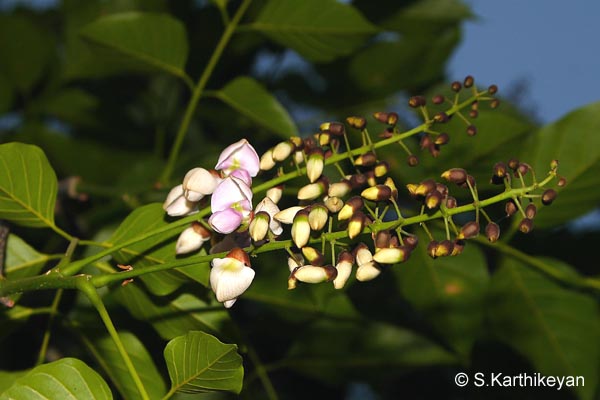
Common Name :Pongam/Indian Beech Tree
Origin :India, Seychelles, Malaya, Ceylon, tropical Australia & China besides some Pacific islands.
Flowering Season :January – March
Vernacular Name :Honge (Kannada)
Brief Description:This native tree has a wide distribution. It is nearly evergreen and hardy.Pongam is medium sized tree. Widely grown due to the many advantages of the species. It can be grown with ease, it is not very slow growing, and has a dense canopy. Apart from the many other uses of the tree, it has been planted in the past for shade along roadsides. The small flowers (similar to the flowers of the pea plant) vary in colour from white to pale purple. It attracts many butterflies like the Cerulean, Blue Tiger and Common Crows. Many of these trees are just coming into bloom in the city.
When these trees sport fresh leaves of a very appealing and enjoyable shade of green it is a pleasure to watch them.
Lagerstroemia flos-reginae
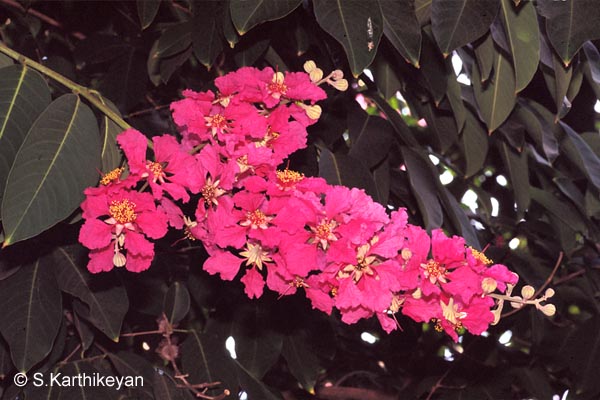
Common Name :Queen’s Flower
Origin :India (W Ghats). Also distributed in Ceylon, Burma, Malay Peninsula, Australia and China.
Flowering Season :March – May
Vernacular Name :Hole dasavala
Brief Description:This species is also known by the name `Pride of India’. It certainly merits both the common names attributed to it. The tree, when it puts forth its many inflorescences, each about a foot long, their colour varying from pink to purple, is a grand sight indeed! The tree attains majestic proportions in well-watered areas, particularly on river and streambeds. Away from water the growth is stunted making it quite suitable for planting in gardens, parks and on roadsides. Never is the tree leafless. The leaves are shed, few at a time and turn red or yellow prior to dropping off, on a scale never equalling the grandeur of temperate trees in autumn. The tree can be easily identified even after the flowering season by the smooth bark (it peels like in guava) and the woody fruits which stay on the tree for a long time – some times even up to the next flowering season.
The trees on M.G.Road (near Brigade Rd. junction) have now given way to the Metro silently. But there are trees in the premises of the City Railway Station, in the vicinity of the High Court and Vidhana Soudha, in Lalbagh and near South End (near Pai Convention Hall) and many other areas in the city.
Couroupita guianensis
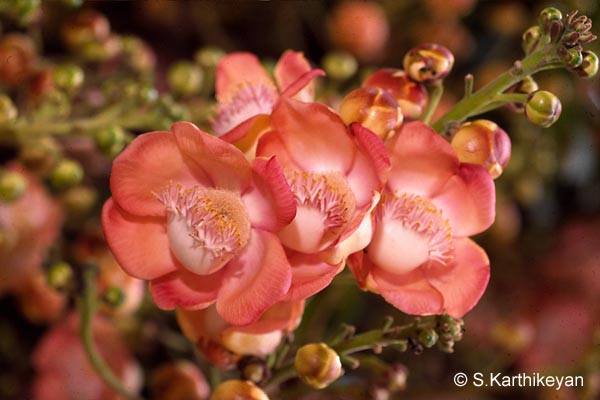
Common Name :Cannon Ball Tree
Origin :Tropical South America and West Indies
Flowering Season :Almost throughout the year
Vernacular Name :Nagalingam
Brief Description:A truly amazing tree. The tree does not grow branches that reach out from the straight trunk. It bears large, showy flowers, almost through the year, on the trunk and not on branches like most other trees. Though a native of tropical South America, it is considered sacred in India (the structure of the flower is likened to the `Shiva linga’, complete with the snake providing shade). The tree also produces globular, brown, woody fruits of an astonishing size, almost the size of a human head! There is also a strong albeit pleasant smell.
A tree in Cubbon Park (near the counter where tickets are issued for boating) is trulyspectacular. There are also trees in Lalbagh, on Infantry Road (near Gem Plaza) and other parts of the city.
Kigelia pinnata
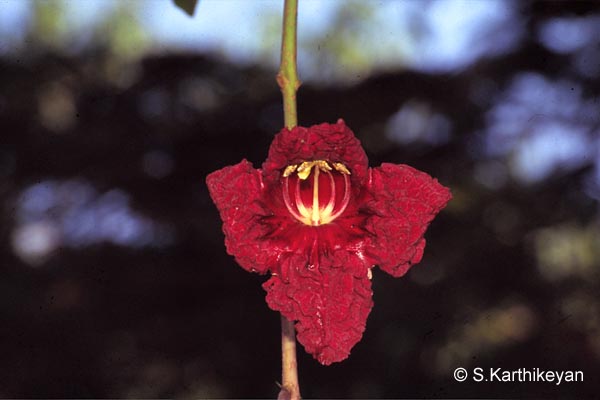
Common Name :Sausage Tree
Origin :Mozambique and parts of tropical Africa
Flowering Season :March to June
Vernacular Name :Sasega mara
Brief Description :Bats are known to pollinate the deep liver / maroon coloured flowers of the Sausage Tree. A few of these foul smelling flowers are borne on a thick long stalk which hangs from branches. The fruits, which give the tree its common name, are sausage (cylindrical) shaped, large, woody and hang on long thick stalks. The Sausage tree is evergreen. It also has a shapely crown and ideal for parks and roadside planting. This tree belongs to the same family as that of the Jacaranda and Tabebuias.
Grevillea robusta
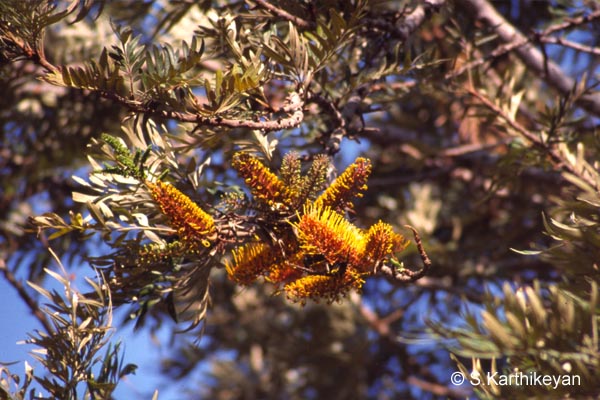
Common Name :Silver Oak
Origin :Australia
Flowering Season :February – March
Vernacular Name :Called silver by coffee plantation workers
Brief description :This tree will be familiar to anyone who has visited coffee/tea estates where it is grown as shade trees. The tree perhaps gets it common name due to the pale, silvery undersides of its ornamental leaves. The orange flowers of this tree are borne in clusters. The Greyheaded Myna and Rosy Pastors can be seen visiting this tree. The tree itself is large, tall and robust. The rough bark of the Silver Oak is often used by many a small creatures like wasps, geckos, etc.
Polyalthia longifolia
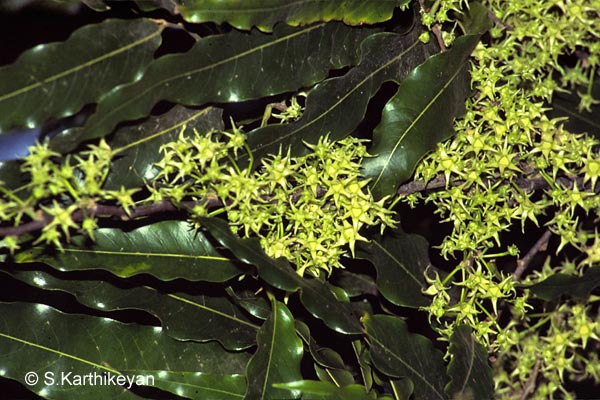
Common Name :Mast Tree
Origin :Sri Lanka
Flowering Season :March – May
Vernacular Name :Ashoka (Kannada)
Brief description :Very often this tree is erroneously called Ashoka (Saraca asoca). The name Mast Tree describes this species better. These trees are evergreen and grow tall. In P.longifolia the long tapering leaves are borne on short slender horizontal branches while in the case of var. pendula similar leaves are borne on drooping branches. Both are ideally suited for planting in a variety of situations. The flowers are pale green with a hint of yellow and not very prominent (particularly in pendula where the foliage conceals the flowers). Bats disperse the fruits. This tree also is the larval food plant of the Tailed Jay butterfly.
Delonix regia
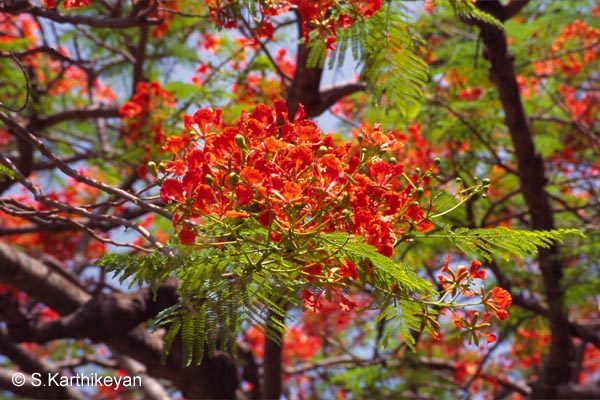
Common Name :Gulmohur
Origin :Madagascar
Vernacular Name :Kattikai mara
Brief description :Gulmohur, though a native of Madagascar, is now common all over India. It is a fast growing species. Truly a spectacular tree when in bloom and otherwise too, owing to its large, flat, spreading canopy. The leaves are feathery and beautiful particularly when young. The tree bursts into bloom with the onset of the hot season. And when it does, it is bereft of leaves and is transformed into a mass of scarlet (although there is some amount of variation in their hues). The flat, foot long pods of this tree are very characteristic and persist. The tree has conspicuous buttresses that at times spread extensively. The Small Green Barbets often find this tree ideal for nesting. These trees add colour to the city when they start blooming.
Cassia javanica
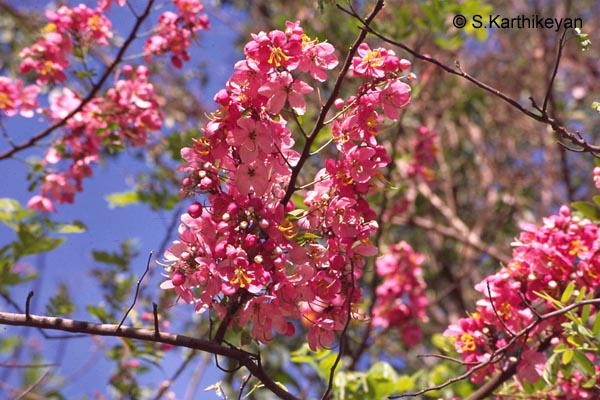
Common Name :Java Cassia
Origin :Java and Sumatra
Flowering Season :April – May
Vernacular Name :None
Brief description :A stunningly beautiful tree, the Java Cassia is a medium-sized tree with a spreading crown. It has a straight trunk, horizontal branches and drooping branchlets which bear the foliage. During winter the tree is leafless and is in flush along with the pink flowers during the hot months. The flowers are clustered on the drooping branchlets amidst the pale green leaves. The flowers that are dark pink turn white with age and during the peak season the ground under the tree is covered with the petals. It adds colour to the area where it is planted. Like most other Cassias it bears long, cylindrical, dark brown pods.
These trees can be seen in Lalbagh (near the Glass House – behind the area used for stalls during the flower shows) and Cubbon Park (near KSLTA). There are two trees in the premises of Hudson Church. However, the best example that I have seen is the one behind the King’s statute (in the other end of Cubbon Park from the Queen’s statue – near Minsk Square).
Solanum grandiflorum
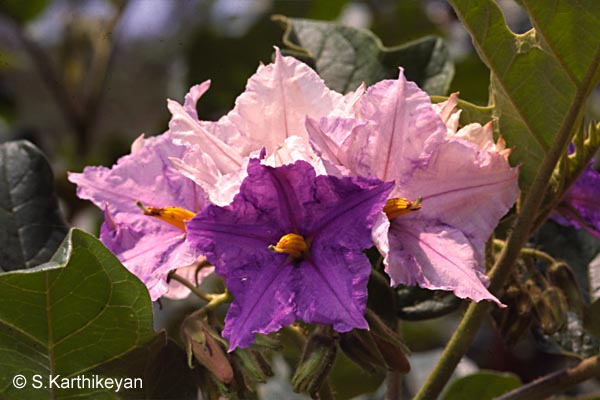
Common Name :Potato Tree
Origin :South America
Flowering Season :Throughout the year
Vernacular Name :None
Brief description :This species grows into a small tree seldom growing over 15 feet and is very ornamental indeed. It has a very proportionate round crown when allowed to grow unhindered. The tree is in flower most of the year. The flowers are dark purple when they are young, turning paler with age. They occur in clusters and flowers of different ages can be seen in each cluster. Hence, at any given point of time the tree has flowers of all shades of purple. The large leaves are deeply indented. The young shoots and the undersides of the leaves are covered with prickles.
Cassia siamea
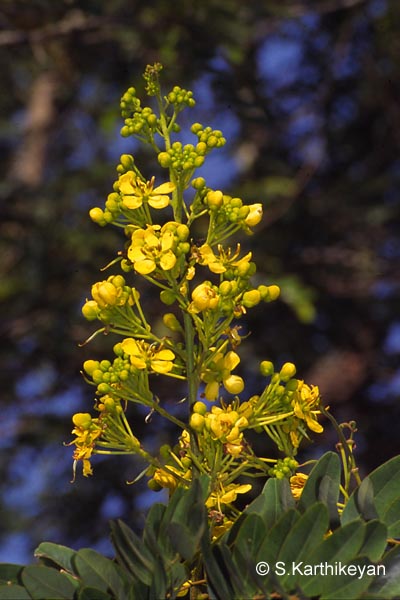
Common Name :Siam Cassia
Origin :Malaya
Flowering Season :Most part of the year
Vernacular Name :None
Brief description :This species is planted as an ornamental and well suited for gardens and parks as it is not a very large tree. The yellow flowers and pods are borne in clusters. Pods are flat and occur simultaneously with the flowers. Parakeets can be seen feeding on the seeds by evicting them from the flat pods. It does very well even in hot, arid conditions and hence of great use in afforesting hot arid areas. This fast growing, evergreen species can be propagated from seed. The larvae of the Emigrant butterfly (Catopsilia sp.) feed on the leaves of this species.
Millingtonia hortensis
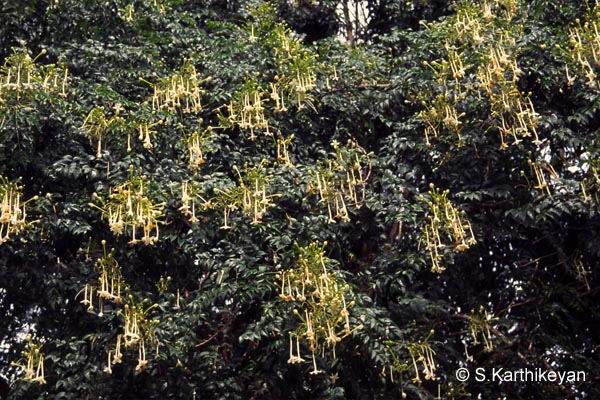
Common Name :Indian Cork Tree
Origin :Burma & Malayan archipelago
Flowering Season :September – October
Vernacular Name :Akasha Mallige
Brief description :A glorious tree though it lacks the bright flowers of many ornamental trees. A lofty tree, grows very tall and straight, the drooping branches laden with whitish flowers add to the beauty of the tree. The trumpet-shaped flowers are white and borne in clusters. The flowers have a pleasant fragrance that fills the air. They form a carpet on the ground during the flowering season. Though the tree drops most of the leaves for a short period during winter it is never completely bare. The bark of the tree has deep fissures and is used as cork, hence the common name. The flowers are thought to be pollinated by nocturnal insects. Even if one has to go a little out of the way to see this tree in bloom, it is worth the while.
Trees in bloom can be seen in the High Court complex – one tree close to the Lord Cubbon’s statute; a series of them planted along the periphery of the Jayanagar Stadium (Madhavan Park) – the road leading from Rani Sarala Devi High School to Jayanagar III Block (Cosmopolitan Club). It should not be difficult for anyone with a good nose to locate these trees when in bloom!
Bauhinia variegata & Bauhinia purpurea
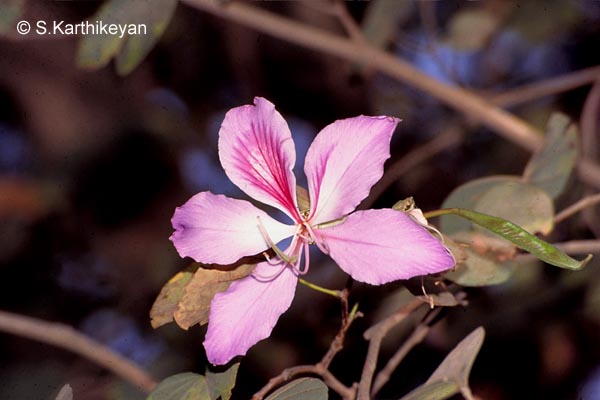
Common Name :Variegated Bauhinia & Purple Bauhinia
Origin :India
Flowering Season :Feb.-April & June-October
Vernacular Name :Basavanapaada
Brief description :Bauhinia variegata and Bauhinia purpurea are very similar looking trees. It is very difficult to tell them apart. The former has very pale pink or white coloured flowers with the some petals variegated while the flowers of the latter are pink to purple. Like in all Bauhinias the leaves are split in the middle which is very characheristic. Both the species considered here are indigenous. B. purpurea comes into flower when in leaf while B.variegata looses most of its leaves when in flower. The trees bear long flat pods which hang and are conspicuous.
One can see trees in Lalbagh, Cubbon Park, Indiranagar, ring road (near Banaswadi) and other areas.
Colvillea racemosa
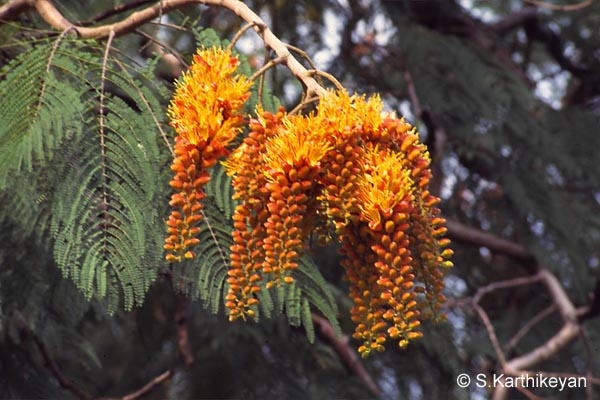
Common Name :Colville’s Glory
Origin :Madagascar
Flowering Season :August – October
Vernacular Name :Hukuchina mara
Brief description :Although it is very similar to Gulmohur in appearance, a mature individual should pose no problems even to a novice when it comes to recognising the tree. The flowering stalks of this tree are held clear of the foliage mainly on the top. Even after the flowering season these stalks persist for a long time. The dark yellowish-orange flowers are arranged in dense clusters on the drooping stalks. Being a medium sized tree, it is well suited for planting on the roadsides, parks and gardens. These trees can be seen at Cubbon Park (Opp. multistoried bldgs.). Since the flowering does not last long one should make it a point to see this tree is bloom.
I distinctly remember seeing Colville’s Glory even before I got interested in natural histoty. Only that I did not have a clue as to what tree it was. The tree that I saw was in Mysore (don’t quite remember the location) and I can still very vividly recollect standing in front of the tree stunned by its beauty.
Firmiana colorata
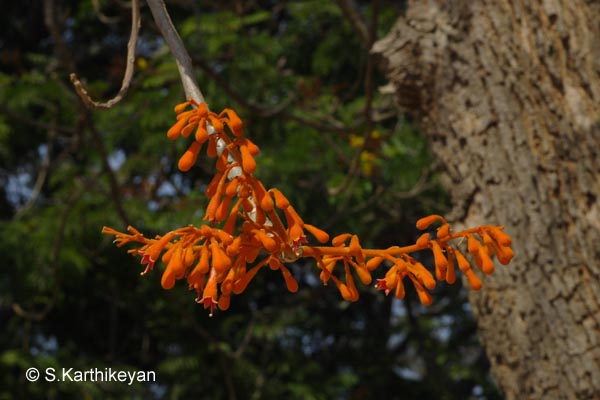
Common Name :Coloured Sterculia
Origin :India, Burma and Ceylon
Flowering Season :February-March
Vernacular Name :None
Brief description :A large tree with large leaves. It flowers when the tree is leafless. The small, scarlet flowers are borne in erect clusters and when touched leaves behind a orange powder on the fingers. After the flowering season, one can seethe seeds -2 in no.- one each attached to a boat shaped leaf-like structure close to the stalk.
A large tree at the entrance of Balbhavan is coming into bloom. There is also one opposite the RBI. There are also trees in Krishna Rao Park and the Bangalore University campus.
This is an uncommon tree in Bangalore. This tree also supports a good no. of birds [refer – Karthikeyan, S (1996) : Bird Attracting Trees and Birds of Shevaroys and Kolli Hills . Newsletter for Birdwatchers : 36(3):49-51]. Keeping this in mind, it may be worth the while to propagate this species.
Jacaranda mimosaefolia
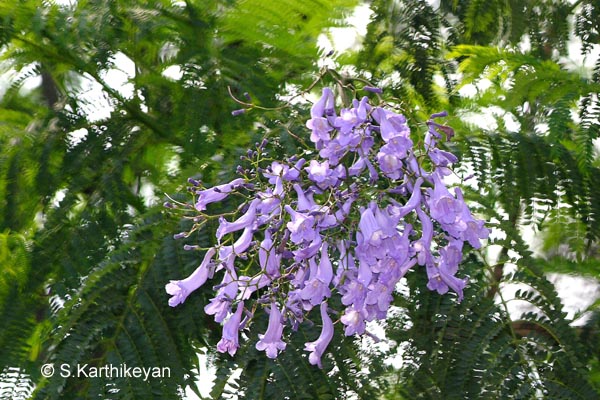
Common Name :Jacaranda
Origin :Brazil
Flowering Season :February-March
Vernacular Name :None
Brief description :Jacaranda is a very beautiful tree and spectacular when in flower. It attains a large size. The tree has a canopy consisting of fine, feathery leaves due to which it has a great ornamental value. The leaves are lost during winter and the bunches of flowers grow when the tree is leafless. The flowers are mauve coloured and tubular. The seeds are enclosed in a round, woody capsule. They hang from the tree for a long time before dropping off. There is flush even when the tree is in bloom. There are many trees that are coming into bloom in the city.
Tabebuia argentea
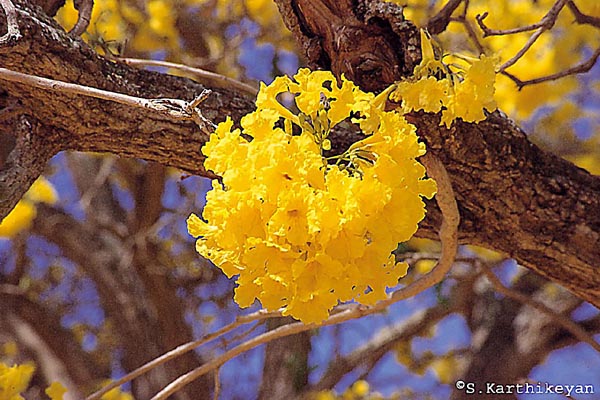
Common Name :The Tree of Gold
Origin :Tropical Americas
Flowering Season :January – March
Vernacular Name :None
Brief description :This tree when in bloom has spectacular yellow blossoms that stand out. It is worth every effort to tend this small tree from South America and wait for it to bloom, though for a short while. It is not very attractive otherwise. The fissured trunk is seldom straight. It has drooping branches that bear long, greyish green leaves in clusters. The tree bears large clusters of bright yellow tubular flowers rendering the tree very conspicuous. The tree is not entirely leafless when in bloom. One can see these trees in the premises of the Bangalore City Railway Station, Vish. Ind. & Tech. Museum – Kasturba Road, several in Cubbon Park, and in many other places in the city.
Milletia ovalifolia
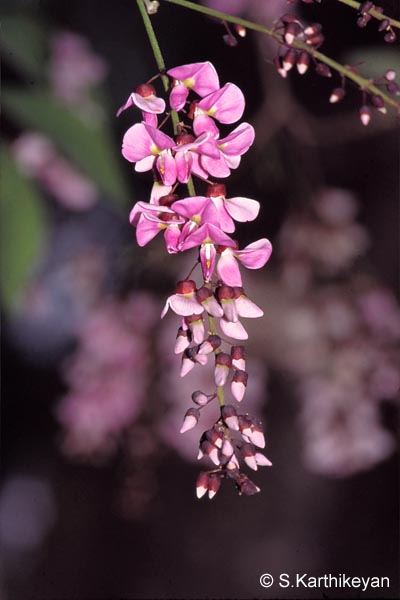
Common Name :Moulmein Rose Wood
Origin :Myanmar (Burma)
Flowering Season :January – February
Vernacular Name :None
Brief description :The Moulmein Rosewood is almost leafless when it comes into bloom. The bright mauve flowers are borne on drooping stalks and very similar to that of the familiar Pongam. The flowers attract plenty of bees. Midway during the flowering season the leaves appear. The leaflets of this tree are small and a very pleasant shade of green when new. The seed pods are flat and contain two to three seeds. This being a medium sized tree can be planted is a variety of situations. These trees can be seen in FM Cariappa Park, Cubbon Park, vicinity of Vidhana Soudha and Lalbagh besides other areas.
Tabebuia avellanedae
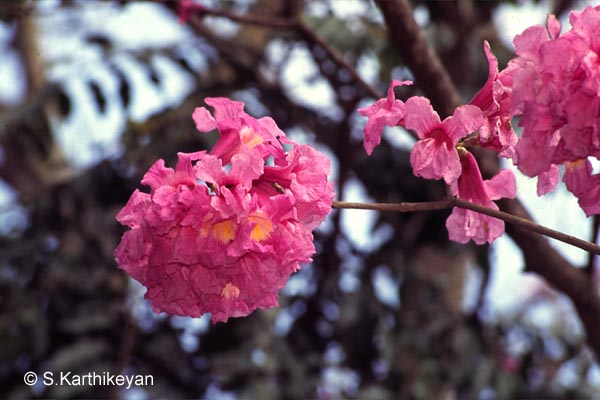
Common Name :Pink Tabebuia
Origin :Paraguay & Argentina
Flowering Season :January – February
Vernacular Name :None
Brief description :A stunningly beautiful tree when in bloom. The Pink Tabebuia is a small statured tree. During most of the year the trees bear very characteristic broad leaflets (five in number) that are pointed at the tip and curved inwards. Prior to bursting into bloom the tree sheds all its leaves. The flowers are deep pink with a pale yellow center and are borne in clusters. Like most other relatives, it can be used as an ornamental very effectively. This species is better suited for this purpose owing to its small stature and they do not attract the axe. All these make it very suitable for planting on avenues.
These trees can be seen in front of Gandhi Statue on M.G.Road, Lalbagh (near the Glass House) and Cubbon Park [near the entrance to Cubbon Park from the Corporation (Hudson circle) side – road leading from Corporation.
Samanea saman
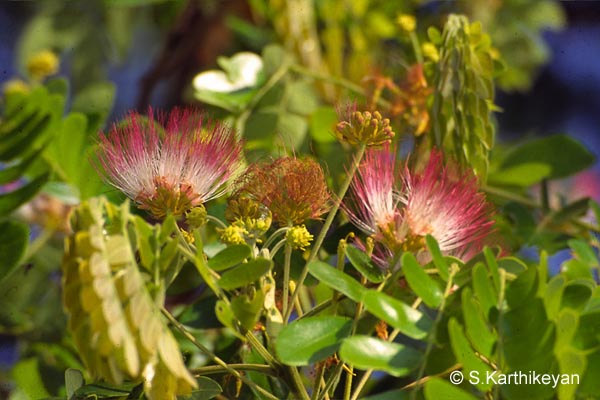
Common Name :Rain Tree
Origin :South America
Flowering Season :March-September
Vernacular Name :Male mara
Brief description :The origin of the common name of this species is uncertain. This large tree has an impressive umbrella-like canopy and it can be quite fascinating to watch the tree do its daily exercise of opening and closing its leaves. The flowers are white and pink resembling an open brush contrasting against the green crown. An ideal species to be planted along broad roads, it also provides for roosting and nesting of many birds.
Tabebuia rosea
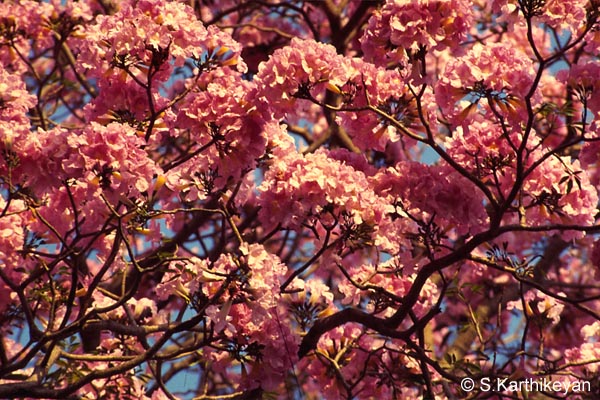
Common Name :Pink Poui
Origin :Mexico, Venezuela, Ecuador
Flowering Season :February-March
Vernacular Name :None
Brief description :A marvellous tree indeed ! It grows large and is very leafy. It provides ample shade when in leaf. Leafs resemble the silk cotton leaves and borne on branches that grow at an angle to the main trunk and seem to reach out to the sky (this feature can be used well to differentiate the T. rosea from a very similar species T. pallida – some botanists can comment on this). Like many flowering trees, it is almost leafless when in bloom. The pale pink flowers grow in clusters similar to the other Tabebuias. It is undoubtedly a splendid tree when in bloom. Ideal for parks and gardens where it can be allowed to grow without being subjected to lopping. Some large trees of this species can be in Cubbon Park, Lalbagh, near National College, Basavangudi, all around Jayanagar 4th Block Shopping Complex and near the GPO.
Parkia biglandulosa
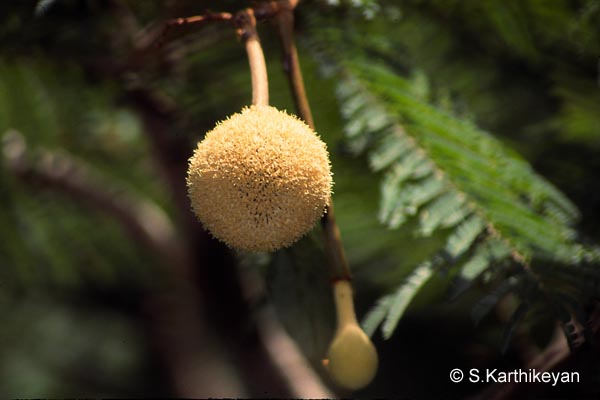
Common Name :Badminton Ball Tree
Origin :Malaya
Flowering Season :October – December
Vernacular Name :Shivalinga
Brief description :This can grow into a large tree indeed with many spreading branches. The leaves are fine and feathery. The inflorescence is similar to a Badminton Ball hanging at the tip of a long thick stalk – the reason for its common name. The fruits that are flat are in clusters at the tip of long thick stalks. Known to grow quite fast. The entire inflorescence has a very soft appearance. However, once the flower is dry the core is pretty hard. Please do not even for fun try flinging it at any one. It really hurts!!
One can see these trees in J.P.Nagar I Phase (opp. the gate of SSMRV college) and also in Cubbon Park.
Spathodea companulata
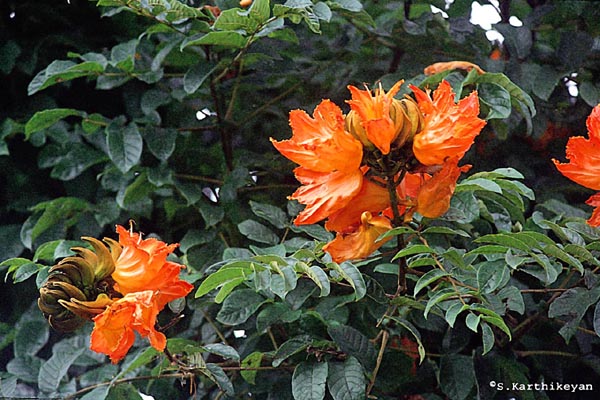
Common Name :African Tulip Tree
Origin :Native of Africa
Flowering Season :August to December
Vernacular Name :Nirukai mara
Brief description :Almost suddenly this species seems to have come into bloom all over town. It is a grand sight particularly where they have been planted at the boundary of parks. A handsome tree bears dark green leaves most of the year. It is in bloom for a long duration providing many birds with nectar from its cup shaped deep-orange flowers. The flowers in clusters held clear off the foliage are in contrast to the green foliage. It is not unusual to find buds of various ages, flowers, and erect, green seed cases in the same cluster. Children squirt the liquid in the buds at each other. The seed cases when mature, become brown and woody. A large transparent, polythene-like, appendage surrounds the tiny brown seed that float in the air before reaching the ground in large quantities. Can be seen at Cubbon Park, Lalbagh and in other parts of the city.
Click here for Flowering Trees – II
Click here to buy your copy of the pocket sized Discover Avenue Trees