Flowering Trees
Mar 23rd, 2008 by Karthik
Bangalore’s charm as a Garden City may have diminished. However, some of the trees that perhaps earned its name are still to be seen and cherished. For those of us who would want to simply immerse ourselves in that moment appreciating the beauty of each of these flowering trees that dot Bangalore it really does not matter …we will continue to do so. For those who would want to know more information about these trees, I have tried to put together some information and pictures for 26 species that are often seen. Eventually, I hope to add more species to this list. Hope you find it useful.
(Updated)Click here to download the PDF
Gliricidia sepium
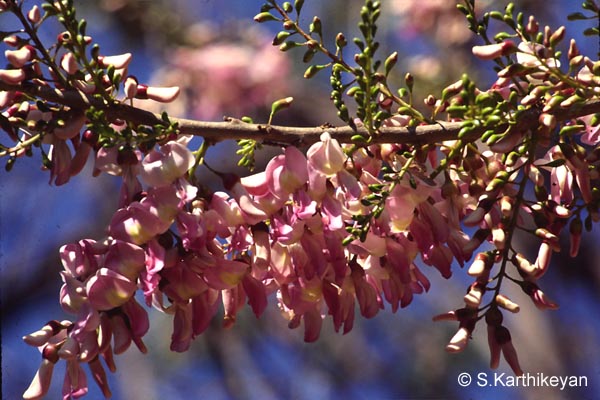
Common Name : Gliricidia, Mother of Cocoa, Quick stick (Jamaica)
Origin : Pacific coast of Mexico and Central America
Flowering Season :February-April
Vernacular Name : Gobbarada mara
Brief Description : A small, deciduous, ornamental tree, planted in gardens and fields as a green manure tree. The tree is leafless when in flower and bears fruits during April and May. The small flowers (barely 2cm long) are pale pink and they are borne in dense clusters on bare twigs. Flowers fade to white / faint purple with age. It can be used as an ornamental. The flowers attract a lot of bees and some lycaenid (Blues-Family Lycaenidae) butterflies - particularly the Peablue Lampides boeticus. There are several of these trees in Lalbagh, Cubbon Park, other gardens and a few along roadsides.
Castanospermum australe
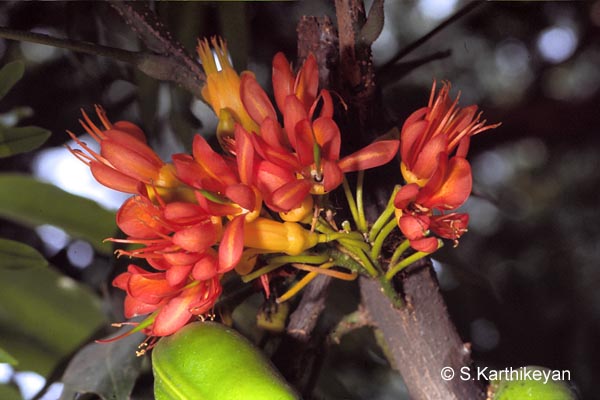
Common Name : Black Bean or the Moreton Bay Chestnut
Origin : Coastal rainforests and beaches in Australia
Flowering Season :February-March
Vernacular Name : None
Brief Description: This is a handsome tree with glossy dark green leaves and low spreading branches when grown in the open. It bears sprays of red and yellow pea-shaped flowers (about 3 to 4 cm long), which are partly hidden by the dense foliage. The nectar produced by the flowers attracts birds, bats and butterflies in its native land. Large woody pods (measuring 12-20cm by 4-6 cm) are produced following flowering. The pods look like large groundnuts. These pods split in two, revealing 2-4 large bean like seeds. The tree is known to contain alkaloids that have been shown to have anti-HIV and anti-cancer properties.
It is an ideal shade tree in parks, resorts and gardens. It is known to have a strong root system, which can be used to consolidate stream banks against erosion.
There are several of these trees in Cubbon Park (the road leading into Cubbon Park opposite old Tiffanys), near the High Court (near the statue of Sir Mark Cubbon), Lalbagh, her gardens and a few along roadsides.
Peltophorum pterocarpum
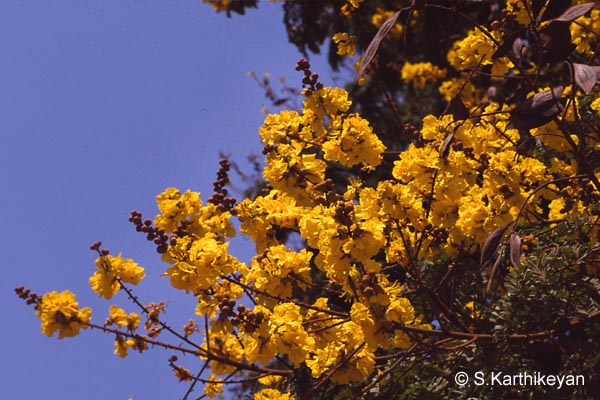
Common Name :Copper Pod
Origin :Ceylon, Andamans, Malaya and North Australia
Flowering Season :March - September
Vernacular Name :Haladi Gulmohur
Brief Description: The Copper Pod is considered to be a semi-evergreen tree. It is seldom leafless though it sheds leaves en masse during the winter months for a very brief period. The name `Copper Pod’ comes from the coppery-red seed cases that are seen in profusion (they turn black with age).
A species which is easy to propagate, hardy, and can survive in harsh conditions. A pretty sight when in bloom. It bears clusters of yellow flowers at the end of the branches, together with dark green leaves. The ground under the tree is strewn with a carpet of the yellow petals and is sight to behold. The tree is large and very shapely.
These trees are in the park flanking Nanda Road (continuation of RV road) from South End to Jayanagar and several other areas of Bangalore.
Bombax malabaricum
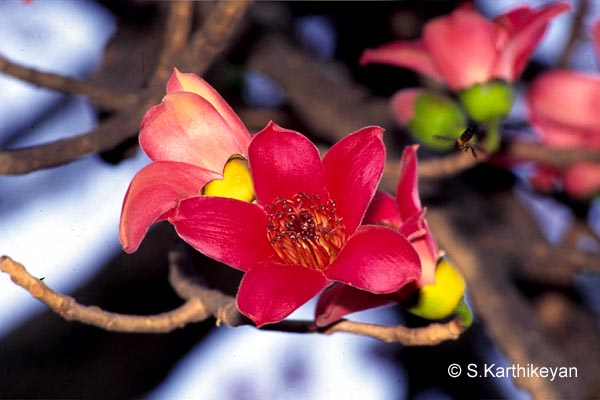
Common Name :Red Silk Cotton
Origin :India and Malaya
Flowering Season :January - March
Vernacular Name :Booruga (Kannada)
Brief Description:The tree is a blaze of colour and completely leafless when in bloom. The numerous, large, cup-shaped, crimson flowers are very attractive. The flowers attract a variety of birds and there is a cacophony of bird calls. Depending on where the tree grows the birds that visit the flowers also vary. Soon after, large green fruits dangle from the tree which turn brown ejecting the soft cotton attached to the seeds.
This is an indigenous, fast growing tree and grows in most areas except in the very arid areas. Virtually every part of the tree is known to have medicinal value. There are trees in Lalbagh (near West Gate and near the Rose Garden), Banashankari II Stage and other areas.
I have personally enjoyed observing birds near these trees in forested areas (particularly Anamalais). Whitebellied Treepie, Hill Myna, Parakeets, Drongos, Orioles, Thrushes, Babblers, Blackbirds and a whole lot more can be seen to the accompaniment of their cacophony. The next time you happen to be in the jungles during the flowering season of this tree, just try your luck.
Pongamia glabra
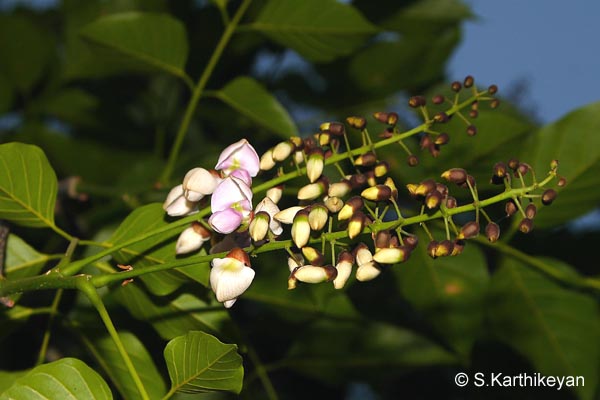
Common Name :Pongam/Indian Beech Tree
Origin :India, Seychelles, Malaya, Ceylon, tropical Australia & China besides some Pacific islands.
Flowering Season :January - March
Vernacular Name :Honge (Kannada)
Brief Description:This native tree has a wide distribution. It is nearly evergreen and hardy.Pongam is medium sized tree. Widely grown due to the many advantages of the species. It can be grown with ease, it is not very slow growing, and has a dense canopy. Apart from the many other uses of the tree, it has been planted in the past for shade along roadsides. The small flowers (similar to the flowers of the pea plant) vary in colour from white to pale purple. It attracts many butterflies like the Cerulean, Blue Tiger and Common Crows. Many of these trees are just coming into bloom in the city.
When these trees sport fresh leaves of a very appealing and enjoyable shade of green it is a pleasure to watch them.
Lagerstroemia flos-reginae
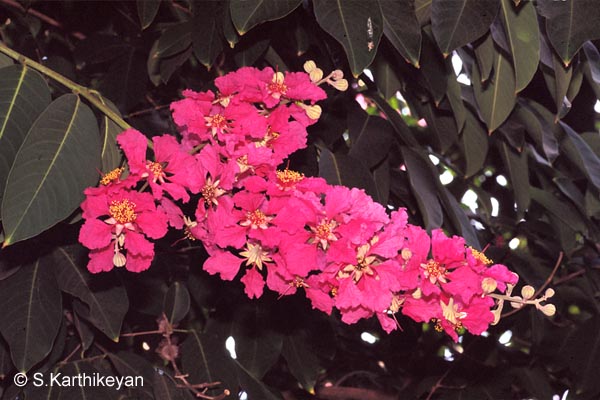
Common Name :Queen’s Flower
Origin :India (W Ghats). Also distributed in Ceylon, Burma, Malay Peninsula, Australia and China.
Flowering Season :March - May
Vernacular Name :Hole dasavala
Brief Description:This species is also known by the name `Pride of India’. It certainly merits both the common names attributed to it. The tree, when it puts forth its many inflorescences, each about a foot long, their colour varying from pink to purple, is a grand sight indeed! The tree attains majestic proportions in well-watered areas, particularly on river and streambeds. Away from water the growth is stunted making it quite suitable for planting in gardens, parks and on roadsides. Never is the tree leafless. The leaves are shed, few at a time and turn red or yellow prior to dropping off, on a scale never equalling the grandeur of temperate trees in autumn. The tree can be easily identified even after the flowering season by the smooth bark (it peels like in guava) and the woody fruits which stay on the tree for a long time - some times even up to the next flowering season.
The trees on M.G.Road (near Brigade Rd. junction) have now given way to the Metro silently. But there are trees in the premises of the City Railway Station, in the vicinity of the High Court and Vidhana Soudha, in Lalbagh and near South End (near RNR choultry) and many other areas in the city.
Couroupita guianensis
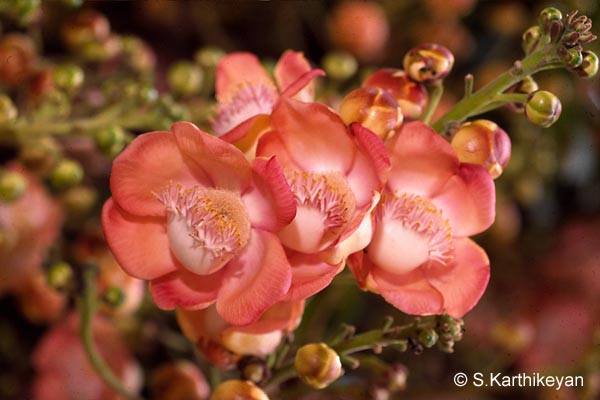
Common Name :Cannon Ball Tree
Origin :Tropical South America and West Indies
Flowering Season :Almost throughout the year
Vernacular Name :Nagalingam
Brief Description:A truly amazing tree. The tree does not grow branches that reach out from the straight trunk. It bears large, showy flowers, almost through the year, on the trunk and not on branches like most other trees. Though a native of tropical South America, it is considered sacred in India (the structure of the flower is likened to the `Shiva linga’, complete with the snake providing shade). The tree also produces globular, brown, woody fruits of an astonishing size, almost the size of a human head! There is also a strong albeit pleasant smell.
A tree in Cubbon Park (near the counter where tickets are issued for boating) is trulyspectacular. There are also trees in Lalbagh, on Infantry Road (near Gem Plaza) and other parts of the city.
Kigelia pinnata
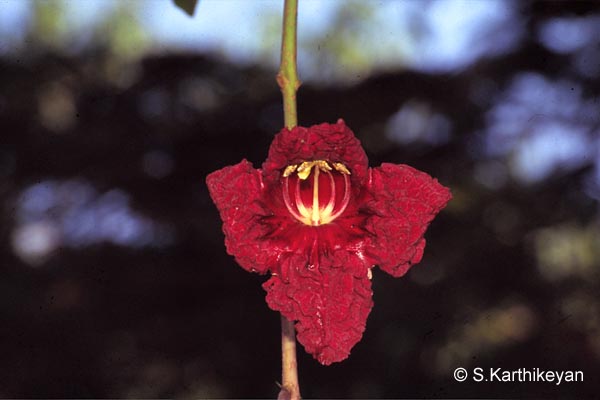
Common Name :Sausage Tree
Origin :Mozambique and parts of tropical Africa
Flowering Season :March to June
Vernacular Name :Sasega mara
Brief Description :Bats are known to pollinate the deep liver / maroon coloured flowers of the Sausage Tree. A few of these foul smelling flowers are borne on a thick long stalk which hangs from branches. The fruits, which give the tree its common name, are sausage (cylindrical) shaped, large, woody and hang on long thick stalks. The Sausage tree is evergreen. It also has a shapely crown and ideal for parks and roadside planting. This tree belongs to the same family as that of the Jacaranda and Tabebuias.
Grevillea robusta
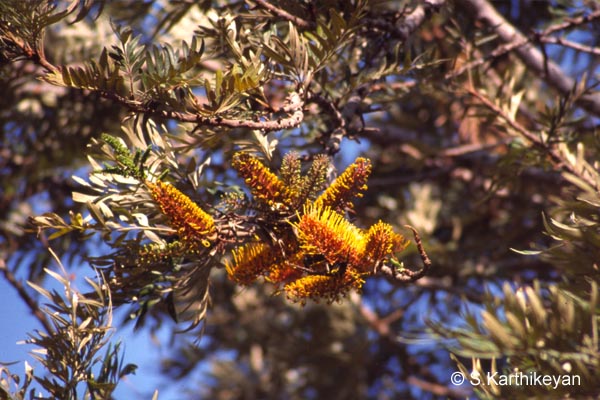
Common Name :Silver Oak
Origin :Australia
Flowering Season :February - March
Vernacular Name :Called silver by coffee plantation workers
Brief description :This tree will be familiar to anyone who has visited coffee/tea estates where it is grown as shade trees. The tree perhaps gets it common name due to the pale, silvery undersides of its ornamental leaves. The orange flowers of this tree are borne in clusters. The Greyheaded Myna and Rosy Pastors can be seen visiting this tree. The tree itself is large, tall and robust. The rough bark of the Silver Oak is often used by many a small creatures like wasps, geckos, etc.
Polyalthia longifolia
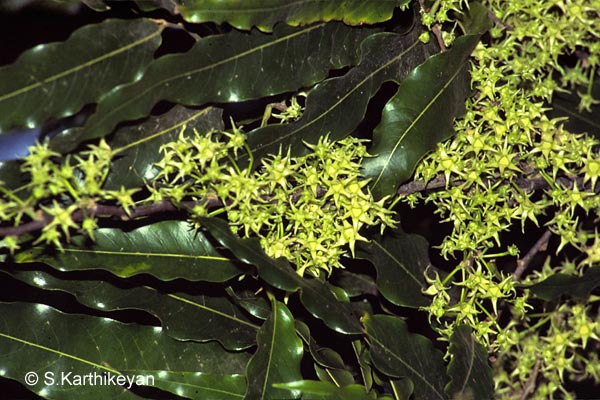
Common Name :Mast Tree
Origin :Sri Lanka
Flowering Season :March - May
Vernacular Name :Ashoka (Kannada)
Brief description :Very often this tree is erroneously called Ashoka (Saraca asoca). The name Mast Tree describes this species better. These trees are evergreen and grow tall. In P.longifolia the long tapering leaves are borne on short slender horizontal branches while in the case of var. pendula similar leaves are borne on drooping branches. Both are ideally suited for planting in a variety of situations. The flowers are pale green with a hint of yellow and not very prominent (particularly in pendula where the foliage conceals the flowers). Bats disperse the fruits. This tree also is the larval food plant of the Tailed Jay butterfly.
Delonix regia
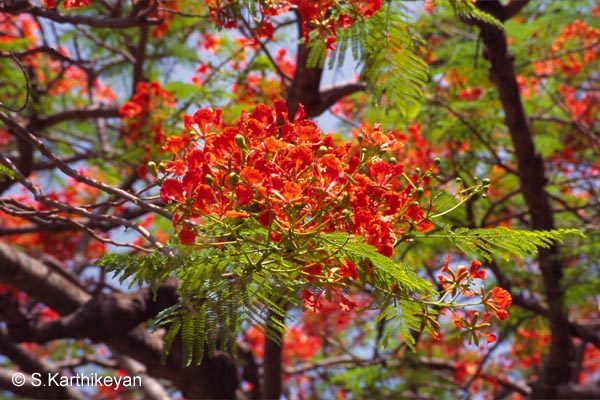
Common Name :Gulmohur
Origin :Madagascar
Vernacular Name :Kattikai mara
Brief description :Gulmohur, though a native of Madagascar, is now common all over India. It is a fast growing species. Truly a spectacular tree when in bloom and otherwise too, owing to its large, flat, spreading canopy. The leaves are feathery and beautiful particularly when young. The tree bursts into bloom with the onset of the hot season. And when it does, it is bereft of leaves and is transformed into a mass of scarlet (although there is some amount of variation in their hues). The flat, foot long pods of this tree are very characteristic and persist. The tree has conspicuous buttresses that at times spread extensively. The Small Green Barbets often find this tree ideal for nesting. These trees add colour to the city when they start blooming.
Cassia javanica
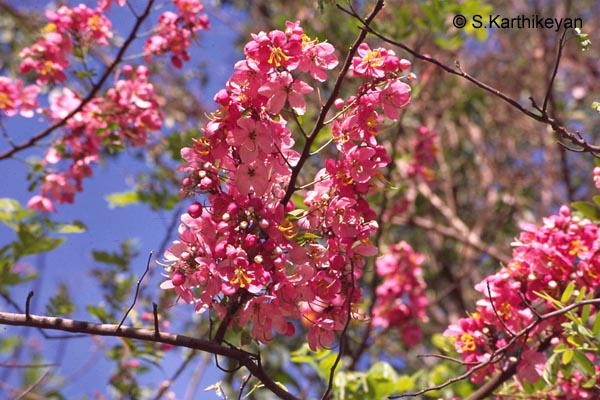
Common Name :Java Cassia
Origin :Java and Sumatra
Flowering Season :April – May
Vernacular Name :None
Brief description :A stunningly beautiful tree, the Java Cassia is a medium-sized tree with a spreading crown. It has a straight trunk, horizontal branches and drooping branchlets which bear the foliage. During winter the tree is leafless and is in flush along with the pink flowers during the hot months. The flowers are clustered on the drooping branchlets amidst the pale green leaves. The flowers that are dark pink turn white with age and during the peak season the ground under the tree is covered with the petals. It adds colour to the area where it is planted. Like most other Cassias it bears long, cylindrical, dark brown pods.
These trees can be seen in Lalbagh (near the Glass House - behind the area used for stalls during the flower shows) and Cubbon Park (near KSLTA). There are two trees in the premises of Hudson Church. However, the best example that I have seen is the one behind the King’s statute (in the other end of Cubbon Park from the Queen’s statue - near Minsk Square).
Solanum grandiflorum
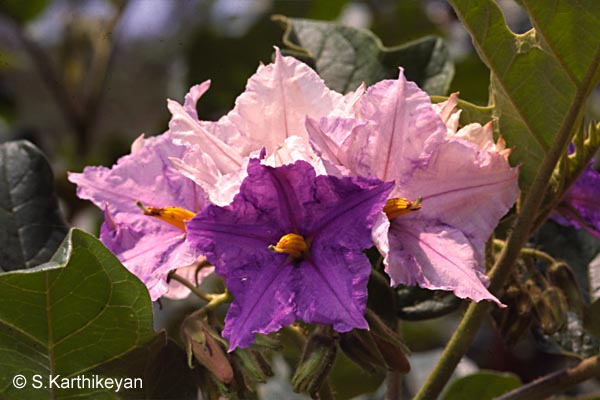
Common Name :Potato Tree
Origin :South America
Flowering Season :Throughout the year
Vernacular Name :None
Brief description :This species grows into a small tree seldom growing over 15 feet and is very ornamental indeed. It has a very proportionate round crown when allowed to grow unhindered. The tree is in flower most of the year. The flowers are dark purple when they are young, turning paler with age. They occur in clusters and flowers of different ages can be seen in each cluster. Hence, at any given point of time the tree has flowers of all shades of purple. The large leaves are deeply indented. The young shoots and the undersides of the leaves are covered with prickles.
Cassia siamea
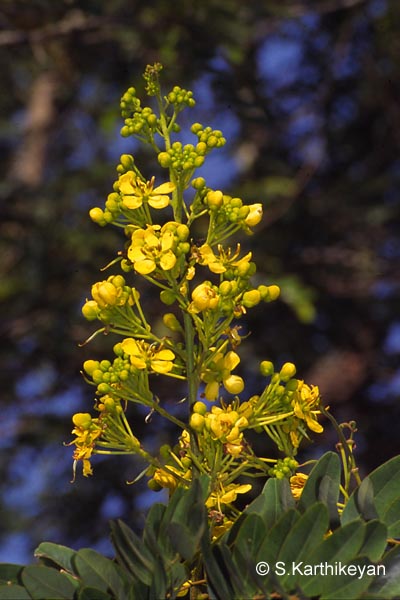
Common Name :Siam Cassia
Origin :Malaya
Flowering Season :Most part of the year
Vernacular Name :None
Brief description :This species is planted as an ornamental and well suited for gardens and parks as it is not a very large tree. The yellow flowers and pods are borne in clusters. Pods are flat and occur simultaneously with the flowers. Parakeets can be seen feeding on the seeds by evicting them from the flat pods. It does very well even in hot, arid conditions and hence of great use in afforesting hot arid areas. This fast growing, evergreen species can be propagated from seed. The larvae of the Emigrant butterfly (Catopsilia sp.) feed on the leaves of this species.
Millingtonia hortensis
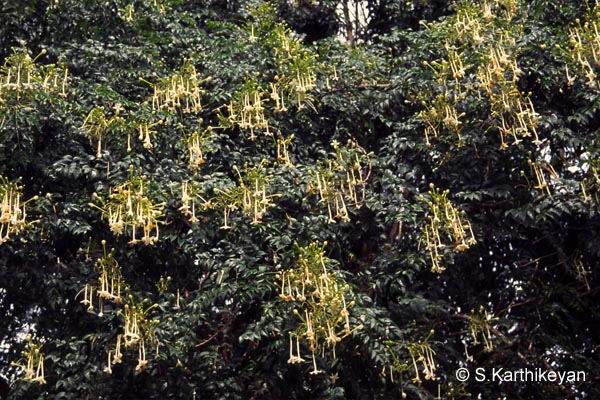
Common Name :Indian Cork Tree
Origin :Burma & Malayan archipelago
Flowering Season :September - October
Vernacular Name :Akasha Mallige
Brief description :A glorious tree though it lacks the bright flowers of many ornamental trees. A lofty tree, grows very tall and straight, the drooping branches laden with whitish flowers add to the beauty of the tree. The trumpet-shaped flowers are white and borne in clusters. The flowers have a pleasant fragrance that fills the air. They form a carpet on the ground during the flowering season. Though the tree drops most of the leaves for a short period during winter it is never completely bare. The bark of the tree has deep fissures and is used as cork, hence the common name. The flowers are thought to be pollinated by nocturnal insects. Even if one has to go a little out of the way to see this tree in bloom, it is worth the while.
Trees in bloom can be seen in the High Court complex - one tree close to the Lord Cubbon’s statute; a series of them planted along the periphery of the Jayanagar Stadium (Madhavan Park) - the road leading from Rani Sarala Devi High School to Jayanagar III Block (Cosmopolitan Club). It should not be difficult for anyone with a good nose to locate these trees when in bloom!
Bauhinia variegata & Bauhinia purpurea
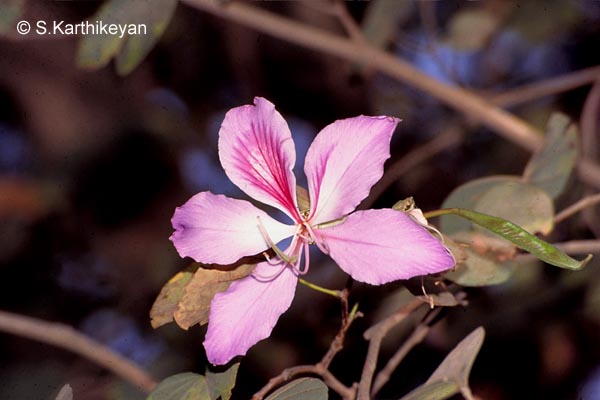
Common Name :Variegated Bauhinia & Purple Bauhinia
Origin :India
Flowering Season :Feb.-April & June-October
Vernacular Name :Basavanapaada
Brief description :Bauhinia variegata and Bauhinia purpurea are very similar looking trees. It is very difficult to tell them apart. The former has very pale pink or white coloured flowers with the some petals variegated while the flowers of the latter are pink to purple. Like in all Bauhinias the leaves are split in the middle which is very characheristic. Both the species considered here are indigenous. B. purpurea comes into flower when in leaf while B.variegata looses most of its leaves when in flower. The trees bear long flat pods which hang and are conspicuous.
One can see trees in Lalbagh, Cubbon Park, Indiranagar, ring road (near Banaswadi) and other areas.
Colvillea racemosa
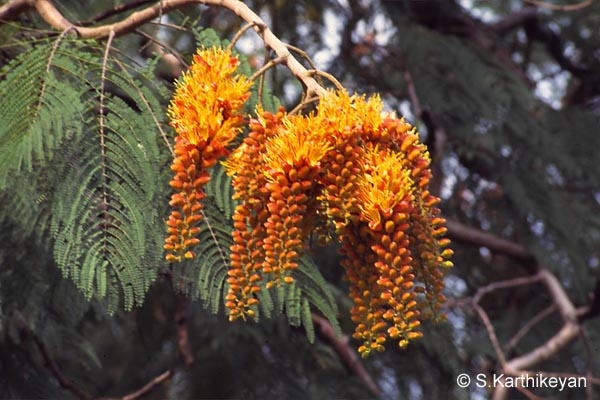
Common Name :Colville’s Glory
Origin :Madagascar
Flowering Season :August - October
Vernacular Name :Hukuchina mara
Brief description :Although it is very similar to Gulmohur in appearance, a mature individual should pose no problems even to a novice when it comes to recognising the tree. The flowering stalks of this tree are held clear of the foliage mainly on the top. Even after the flowering season these stalks persist for a long time. The dark yellowish-orange flowers are arranged in dense clusters on the drooping stalks. Being a medium sized tree, it is well suited for planting on the roadsides, parks and gardens. These trees can be seen at Cubbon Park (Opp. multistoried bldgs.). Since the flowering does not last long one should make it a point to see this tree is bloom.
I distinctly remember seeing Colville’s Glory even before I got interested in natural histoty. Only that I did not have a clue as to what tree it was. The tree that I saw was in Mysore (don’t quite remember the location) and I can still very vividly recollect standing in front of the tree stunned by its beauty.
Firmiana colorata
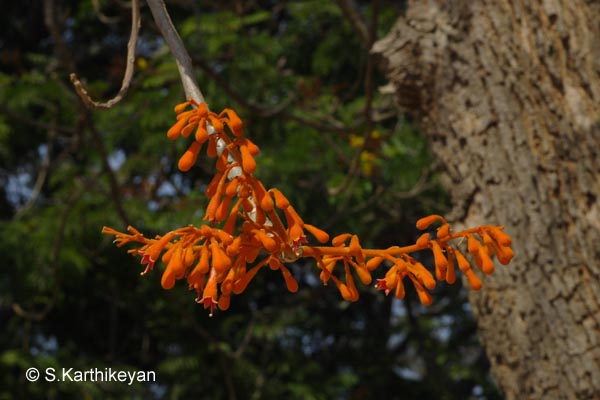
Common Name :Coloured Sterculia
Origin :India, Burma and Ceylon
Flowering Season :February-March
Vernacular Name :None
Brief description :A large tree with large leaves. It flowers when the tree is leafless. The small, scarlet flowers are borne in erect clusters and when touched leaves behind a orange powder on the fingers. After the flowering season, one can seethe seeds -2 in no.- one each attached to a boat shaped leaf-like structure close to the stalk.
A large tree at the entrance of Balbhavan is coming into bloom. There is also one opposite the RBI. There are also trees in Krishna Rao Park and the Bangalore University campus.
This is an uncommon tree in Bangalore. This tree also supports a good no. of birds [refer - Karthikeyan, S (1996) : Bird Attracting Trees and Birds of Shevaroys and Kolli Hills . Newsletter for Birdwatchers : 36(3):49-51]. Keeping this in mind, it may be worth the while to propagate this species.
Jacaranda mimosaefolia
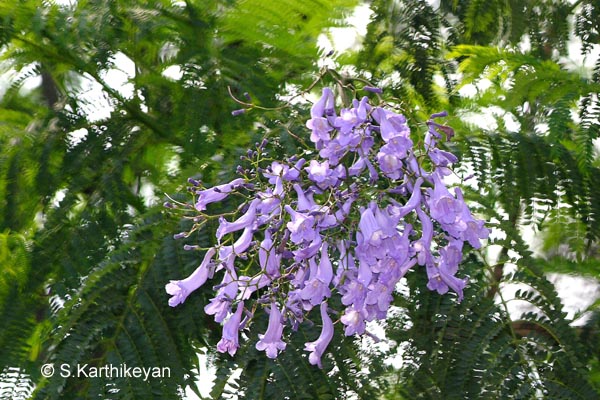
Common Name :Jacaranda
Origin :Brazil
Flowering Season :February-March
Vernacular Name :None
Brief description :Jacaranda is a very beautiful tree and spectacular when in flower. It attains a large size. The tree has a canopy consisting of fine, feathery leaves due to which it has a great ornamental value. The leaves are lost during winter and the bunches of flowers grow when the tree is leafless. The flowers are mauve coloured and tubular. The seeds are enclosed in a round, woody capsule. They hang from the tree for a long time before dropping off. There is flush even when the tree is in bloom. There are many trees that are coming into bloom in the city.
Tabebuia argentea
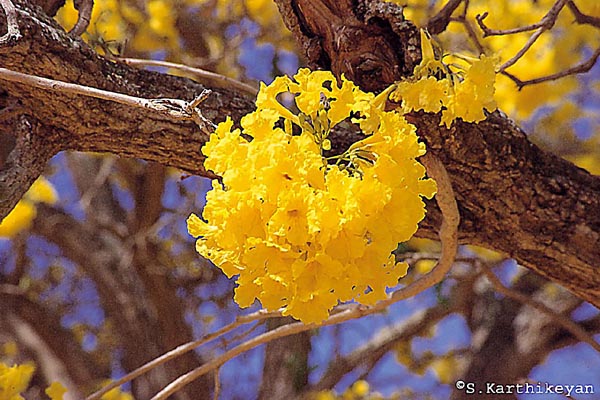
Common Name :The Tree of Gold
Origin :Tropical Americas
Flowering Season :January – March
Vernacular Name :None
Brief description :This tree when in bloom has spectacular yellow blossoms that stand out. It is worth every effort to tend this small tree from South America and wait for it to bloom, though for a short while. It is not very attractive otherwise. The fissured trunk is seldom straight. It has drooping branches that bear long, greyish green leaves in clusters. The tree bears large clusters of bright yellow tubular flowers rendering the tree very conspicuous. The tree is not entirely leafless when in bloom. One can see these trees in the premises of the Bangalore City Railway Station, Vish. Ind. & Tech. Museum - Kasturba Road, several in Cubbon Park, and in many other places in the city.
Milletia ovalifolia
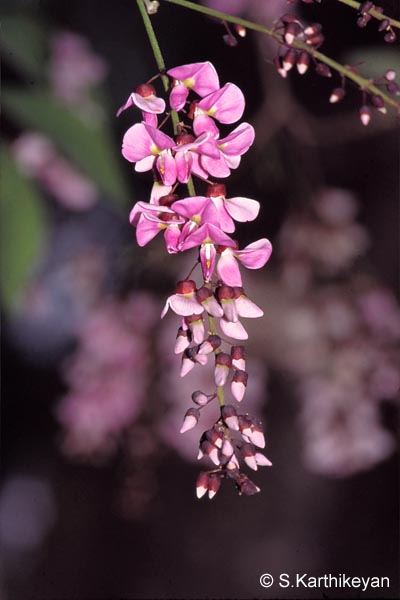
Common Name :Moulmein Rose Wood
Origin :Myanmar (Burma)
Flowering Season :January – February
Vernacular Name :None
Brief description :The Moulmein Rosewood is almost leafless when it comes into bloom. The bright mauve flowers are borne on drooping stalks and very similar to that of the familiar Pongam. The flowers attract plenty of bees. Midway during the flowering season the leaves appear. The leaflets of this tree are small and a very pleasant shade of green when new. The seed pods are flat and contain two to three seeds. This being a medium sized tree can be planted is a variety of situations. These trees can be seen in FM Cariappa Park, Cubbon Park, vicinity of Vidhana Soudha and Lalbagh besides other areas.
Tabebuia avellanedae
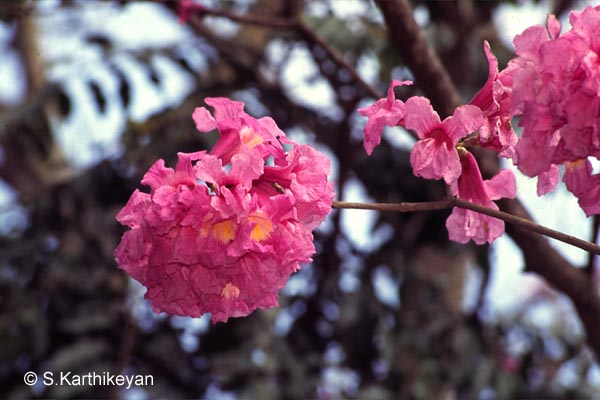
Common Name :Pink Tabebuia
Origin :Paraguay & Argentina
Flowering Season :January – February
Vernacular Name :None
Brief description :A stunningly beautiful tree when in bloom. The Pink Tabebuia is a small statured tree. During most of the year the trees bear very characteristic broad leaflets (five in number) that are pointed at the tip and curved inwards. Prior to bursting into bloom the tree sheds all its leaves. The flowers are deep pink with a pale yellow center and are borne in clusters. Like most other relatives, it can be used as an ornamental very effectively. This species is better suited for this purpose owing to its small stature and they do not attract the axe. All these make it very suitable for planting on avenues.
These trees can be seen in front of Gandhi Statue on M.G.Road, Lalbagh (near the Glass House) and Cubbon Park [near the entrance to Cubbon Park from the Corporation (Hudson circle) side - road leading from Corporation.
Samanea saman
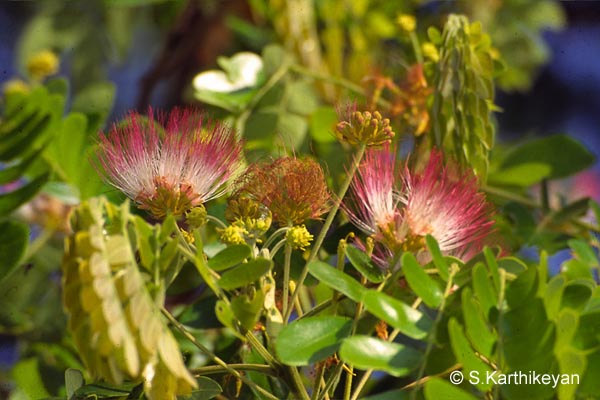
Common Name :Rain Tree
Origin :South America
Flowering Season :March-September
Vernacular Name :Male mara
Brief description :The origin of the common name of this species is uncertain. This large tree has an impressive umbrella-like canopy and it can be quite fascinating to watch the tree do its daily exercise of opening and closing its leaves. The flowers are white and pink resembling an open brush contrasting against the green crown. An ideal species to be planted along broad roads, it also provides for roosting and nesting of many birds.
Tabebuia rosea
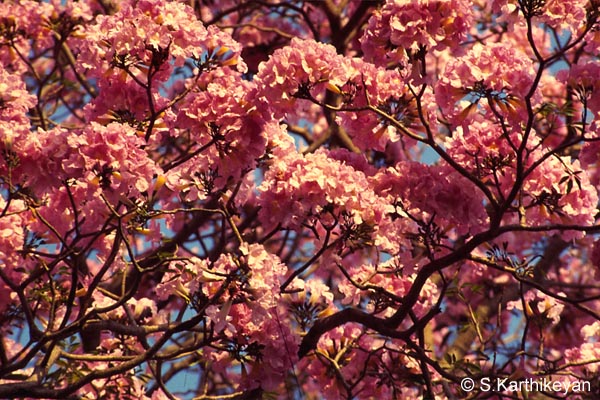
Common Name :Pink Poui
Origin :Mexico, Venezuela, Ecuador
Flowering Season :February-March
Vernacular Name :None
Brief description :A marvellous tree indeed ! It grows large and is very leafy. It provides ample shade when in leaf. Leafs resemble the silk cotton leaves and borne on branches that grow at an angle to the main trunk and seem to reach out to the sky (this feature can be used well to differentiate the T. rosea from a very similar species T. pallida - some botanists can comment on this). Like many flowering trees, it is almost leafless when in bloom. The pale pink flowers grow in clusters similar to the other Tabebuias. It is undoubtedly a splendid tree when in bloom. Ideal for parks and gardens where it can be allowed to grow without being subjected to lopping. Some large trees of this species can be in Cubbon Park, Lalbagh, near National College, Basavangudi, all around Jayanagar 4th Block Shopping Complex and near the GPO.
Parkia biglandulosa
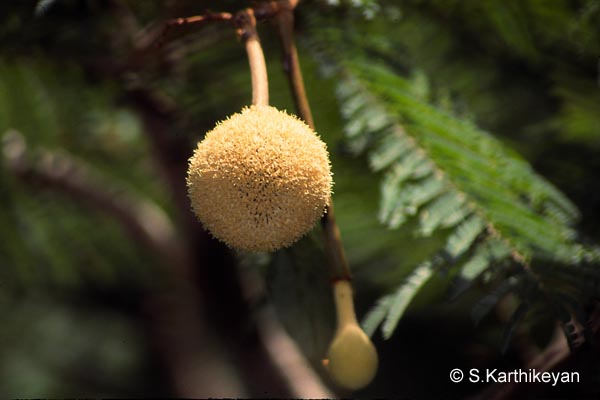
Common Name :Badminton Ball Tree
Origin :Malaya
Flowering Season :October - December
Vernacular Name :Shivalinga
Brief description :This can grow into a large tree indeed with many spreading branches. The leaves are fine and feathery. The inflorescence is similar to a Badminton Ball hanging at the tip of a long thick stalk - the reason for its common name. The fruits that are flat are in clusters at the tip of long thick stalks. Known to grow quite fast. The entire inflorescence has a very soft appearance. However, once the flower is dry the core is pretty hard. Please do not even for fun try flinging it at any one. It really hurts!!
One can see these trees in J.P.Nagar I Phase (opp. the gate of SSMRV college) and also in Cubbon Park.
Spathodea companulata
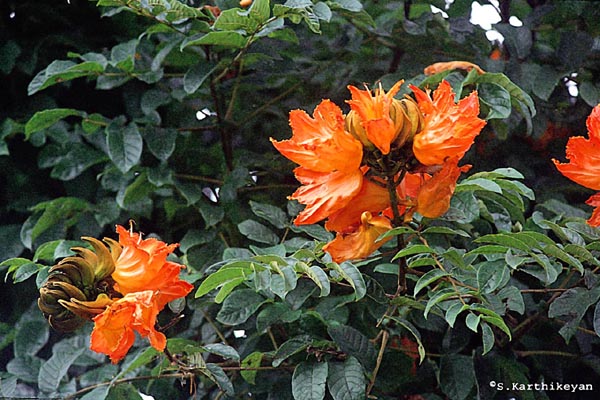
Common Name :African Tulip Tree
Origin :Native of Africa
Flowering Season :August to December
Vernacular Name :Nirukai mara
Brief description :Almost suddenly this species seems to have come into bloom all over town. It is a grand sight particularly where they have been planted at the boundary of parks. A handsome tree bears dark green leaves most of the year. It is in bloom for a long duration providing many birds with nectar from its cup shaped deep-orange flowers. The flowers in clusters held clear off the foliage are in contrast to the green foliage. It is not unusual to find buds of various ages, flowers, and erect, green seed cases in the same cluster. Children squirt the liquid in the buds at each other. The seed cases when mature, become brown and woody. A large transparent, polythene-like, appendage surrounds the tiny brown seed that float in the air before reaching the ground in large quantities. Can be seen at Cubbon Park, Lalbagh and in other parts of the city.
This page has the following sub pages.
Great job Karthik. Fills in a big gap for a lot of junta like me. Very informative.
Wonderful Karthik! Almost all the info in one convenient place. Thank you so much! I can send everyone to this page now! Thanks to Anush for his help too.
Great Job Kartik !
Any case one doesn’t expect any less from you. Why don’t you do a similar journal on Butterflies and Lizards. At least lizards of the Deccan. Don’t forget to include my friend the Agama.
Beautiful piece of info Karthik! Thanks for sharing this
Thanks folks. I really hope that you will find it useful. Thanks to Anush who put up the material for all of you to see. Besides helping solve many minor issues from time to time, I would not have been able to bring this to all of you without his help.
What a collection! Encyclopedic!! Wonderful effort, Karthik - now all you need to do is to publish this as a book so we can carry it around like we carry Grimskip!
Excellent post Karthik. very very useful and informative. DO you think you can put up a PDF version of the same ?
Wonderful article, info also guides us where we can look for insects and birds, eagerly waiting for more..
Very very useful and much needed information Karthik, I have been searching for something like this for sometime now, thanks a ton for putting it all together, and thanks to Anush for posting it.
Good Job Karthik !
Thanks a lot for the excellent postings Karthik!
I would like to add one sentence regarding African Tulip Tree.
I have seen its pods being fed upon with a lot of gutso by squirrels and rose ringed parakeets from my office window!
I second Kalyan Varma’s request for a .pdf!
Great work! Hope to see more!
Keep up the good work Karthik!
In good faith,
Krishna, Bangalore.
Making free time is Culture!
Thanks for the excellent post Karthik, it will be very helpful to us.
Very beautifully brought out Karthik.
Ranjini
Hey Karthik,
A very usefull link i must say.
Lovely piece of information…TFS!
that is really, really useful.
I have a ‘potato tree’ in my garden, and I was told by someone that it is called ‘wild brinjal’(kaadu badane)..and that is the name i have given everyone till now..is that name also correct? (i guess they are all solanaceae, but still?)
thanks for all the kannada names..that makes it so interesting..correlating the names we read in kannada books with the actual trees
would love it if you could post pictures of the leaves (actual size if possible, sometimes the blown up versions are confusing
so that we can identify them during the non flowering season also..
Simply Great……..
Very informative and useful stuff !! Great work Karthik ji..
Karthik and Anush,
Thank you so much. This is a boon to people who wonder the names of so-many beautiful trees of Bangalore. Quite handy when you purchase saplings as well. It is very comprehensive and is complimented with the detailed pictures too. Thanks so much for the effort.
[…] Karthik has a wonderful and comprehensive listing (with pictures and information) of the 26 species of flowering trees that are often seen around Bangalore. […]
Awesome Karthik,
I have always wondered about the origin and names of the roadside trees in Bangalore, there is so much variety. Even got this book ‘’Urban forestry'’ by Dr.Neginhal.
Great job, really and keep going !
Thanks
shamala
A job well done! As a newcomer to Bangalore and South India, I am astonished by the vivacity of the colors reflected in the snapshots. Thanks for the herculean effort.
Regards,
Very nice. How about adding some location maps or Google placemarks. See http://www.google.com/apis/maps/gallery/mapsAPIProducts.html
It would be nice if people could then share their own tree discoveries ! For instance there is a Coleville’s glory I saw in bloom somewhere recently and would like to share its location.
Thanks once again. I have noted all the suggestions that have been made both on and off the blog. Let me see how many of these I can handle.
Awesome info !
Good stuff!
Thanks to Anush and you!
All I knew all along was Tabebuia rosea as pointed out by Mr. Nainan (Bishop Cottons, circa early 90’s). We had (have?) one of those in what is now known as Elphick park within the school campus and he pointed it out during our morning assembly.
But what you’ve provided will definitely help getting my kid-cousins understand what a wonderful city they live it!
Nice article Karthik! Now I am armed with more info showing visitors the charms of the Garden city.
Karthikeyan,
Thanks for this wonderfull information. We enjoyed going through it. I with my 7 yr old daughter did a nice excercise relating to your page at MN Krishna Rao Park in Basavanagudi. We tried to indentify trees in the park using the pictures here. We were able to find the following:
- Black bean
- Tree of Gold
- Gulmohar
- Jacaranda
- Honge Mara or Indian Beech Tree
- Rain Tree
- Potato Tree
- Copper Pod or Haladi Gulmohar
Thanks to you, now we know the names also!
Terrific job. Just the kind of thing I have been longing for whenever I pass through bangalore roads and someone asks me to name a beautiful flowering tree. Here they are, right from the expert’s mouth.
Thanks and felicitations.
Great work Kartikeyan! Great help for teachers. Thank you very much.
Many thanks for this. A treat for the senses and most informative. If there are similar illustrated and easily accessible lists for other Indian cities, they would be as much of a delight to go through. Maybe bloggers elsewhere have taken up this challenge?
Mr. Karthik,
Great job, and very good information
Regards,
nagaraj K
What a beautiful, organized and helpful site for research.
Nice effort, informative, easily accessible, good collection from almost throughout India.
Karthikeyan
Good collections and came to know about the local names.
Want to plant some. Very informative to students for their project work.
Hi Karthik,
Thanks for taking me on pleasant childhood memories lane of playing with some of these flowers you have mentioned… for example… Nagalingam, which still grows in plenty in some of the old, rumbling residences in Malleshwaram…… Kattikai Mara, which is time pass in summer holidays….. playing with its flowers ….”kole Jagala (Cockfight)”…
Nirukai Mara…. such fun we used to have as kids squirting the buds at each other….. we as kids used to have a different name altogether as “Uuche Kai (Piss bud)”…
Beautiful post. Brought back wonderful memories of the 80s when I was at IISc. What about margosa and sampige? Are they just names of roads?
wonderful post.
Absolutely stunning stuff , Karthik ! This will give my kids a great project to work on during their summer holidays. We stay near Mini Forest , JP Nagar III Phase, where there are several trees that you have named and when in full bloom they are an awesome sight indeed ! We are indeed fortunate to live in a city like Bangalore and more fortunate to have great bloggers like you who put us in touch with glorious mother Nature ! Keep up the good work !
Wonderful exhibit! Congratulations to you, Sir!
Great work, Karthik. Living in Toronto, you almost made me cry for my home.
great job sir, nice pics and wonderful text.
Jacaranda mimosaefolia’s flower is called Neeli Padri hoovu.
How Beautiful !
And I am reminded of these words;
Flowers are not made by singing “Oh, how beautiful,”
and siting in the shade - by Rudyard Kipling
Plant a tree- today!
Excellent work! Keep it up! Please also add up if possible beautiful climbers and ornamental shrubs which are now blooming!
Great job! Nice to do a book along the lines of Trees of Delhi and Trees of Mumbai.
I thought that it was “Hutchekai Mara” not “Nirukai Mara”!
Hi once again !
Spathodea companulata - African Tulip Tree is known by both the names. If you noticed Mr. Prasad Rao also have given the vernacular name as Uuchekai mara.
Thanks to all those who have read through and shared additional information with everyone.
Its wonderful information. Everybody is happy.
Let us enjoy & update our knowledge.
Thanks a lot
with love & gratitude!!
sandip
My salutes to you Karthi…….This showcases the perfect blend of scientist and an artist within you………… honey bees may not get nectar out of these pictures but i will definitely get the nectar of information posted. Thanks for the effort….
Hi Karthik,
This page has become almost like a Bible! The more I read it, the more I discover. My evening walks back home have become so exciting - observing, appreciating and trying to identify trees. The first thing I want to do after getting back home is to refer to this page. Thanks a ton Karthik, you’ve opened a new world of flowering trees for me!
Pallavi
Hi Karthik , i would like to congratulate you for your amazing work. It’s a wonderful piece of work and a great information. Thanks for sharing this information and the pictures look so beautiful and make you feel happy.
What a lovely blog you have and how glad I am to read this particular post. Having been a student of Botany, I appreciate this all the more. Thanks for sharing such an interesting post and fabulous pictures.
Wow! What a beautiful collection of Flowering Trees, and with great info too! Great job!
I wish to just make some comments on Bauhinia. Actually Bauhinia variegata and Bauhinia purpurea flowers are quite different. B. variegata (called kachnaar in Hindi) has broad petals, which overlap with each other unless the flower is fully open. On the other hand, petals of B. purpurea (Purple Orchid Tree) are quite narrow, and never overlap with each other. Purple Orchid Tree flowers can very greatly in color. We have seen specimens which have completely white flowers, with only a minor streak of purple. Flowering time different for the two. Kachnaar flowers in March, whereas Purple Orchid Tree flowers in October-November.
Once again, great job!
- Tabish
http://www.flowersofindia.net
What a fantastic collection of photos, quite apart from directions on where the specimen can be found!
It makes me wish I lived in Bangalore.
Please do something like this for us Chennai-ites.
Congratulations! You’ve done it again!
Looking at flowers on a tree is a huge pleasure in itself…Give that tree a name and how complete that pleasure becomes! Thanks Karthik for identifying these marvels of nature for us. Looking forward to more such activity at this site! You make it truly alive!
M Tobin
Just wanted to make the comment count 57!
I must rub it in Karthik. You keep too low a profile for the kind of knowledge base you have. I am so glad you have done this list; please make more lists of other creatures from creation too.
Wow!!! Just wow !!! easily the best resource on Bangalore trees ever!!! I have been searching for such a thing for ever…thanks a ton boss…
Wow! Wonderful collection of common trees…great pictures
with interesting text. Hope to see more and please include some common herbs as well.
Keep it up Karthi.
Bhanu
Great work Kartik, especially in catalouging flowers we stare at each day and never go beyond the colours. I am an avid admirer of nature be it birds, trees, water bodies, butterflies…. and been on the search for a site which captures at one place all that a common eye gets to see in bangalore and its neighbourhood. I wish your blog moves beyond to be a website with photographic search function based on color, common name, sighting, etc.
Kudos… and keep it up…. sounds a bit patronising ? Ooops ! sincerely did not intend it to be so.
Hi Karthik,
Thanks a lot for this wonderful information. I can feel your love for Bangalore in these beautiful photos. Suddenly, all those nameless roadside trees seem to have come to life. I feel they are talking to me, sharing many secrets with me, when I am going back home after a day’s hard work.
There is a big tree with blue flowers in my office compound. I never knew that was a jacaranda until now. Thanks a lot. I think there may be some more obscure trees in Bangalore vying for attention. Please add them to this album so it will very useful for city bums like us.
i love trees
this was very beautiful
try to get some more specially trees from delhi and the north indian names too
Dear Sirs,
I was in search of such site and my dreams for selecting flowering trees for my field boundary about 800 feet became
true.
Thanks,
Please inform per return mail the name of Nurseries in india where the same is available so i can quench my thurst for planting flowering trees on field boundary.
Thanks & regards,
Rajendra Singh Pawar(Of Berchha)
Dear Karthik,
Fantastic!!!
Do you have pictures of these trees in bloom I am searching for such pictures and would be grateful if you could mail them to me.
Regards,
V.Shankar
Hi Karthik!!
How fabulous your website is! Thoroughly enjoyable, great viewing, lovely pictures, informative write ups! This is probably the only one of its kind, listing so much info about so many variegated trees…..you have scored magnificently on this one! Bravo!!
Living overseas makes one very reminiscent about the scents of Indian flora and fauna, and you have spread that aroma around the world with your well researched show-gallery!
THANK YOU - Lots warm regards!!
Preeti
dear sir,
Your blog is funtastic..! you done it excellent..!
please send me a mail describing some of the non-flowering trees in Bangalore; my mail ids are :- keyes@sify.com
and shibuthoppil@yahoo.com
yours,
Shibu.
I grew up in Bangalore and miss it and it’s trees. I remember some particulary more than others - a few that you have named and their locations.
Thank you very much for your effort.
With appreciation,
KC
I am looking for a large pictoral book of South American Trees. Do you know of any?
Respectfully, Larry Fey
Karthik,
Im looking for about 15 species of trees/flowering plants that were native to Bangalore. It seems that with the plants that the Brits bought to Bangalore, very few people know the native plants.
Hi Karthik,
Great work. Now a request. is it possible to let people know how to go about fetching these tree sampling & find a channel to distribute it as well. Just an idea not sure about the details on how we would do it.
Regards
This gives me the satisfaction that I still continue to live in garden city.
I stumbled upon this collection of amazing photos and information a couple of weeks ago, while searching for pictures of Mumbai flora to send to a horticulturist friend abroad. Thanks so much for sharing your beautiful photos and knowledge!! I just *had* to come back for another visit! And will surely be back again.
Hi Kartihk,
Awesome information ….hope your collection still grows.Great job
sir
your website give me lot of information thanks
Hello
Its a very beautiful collection of photos of wild flowers and trees and details. Many people will be attracted to plant such trees. It would be very nice if you could indicate the location where these plants would be available for sale.
Congratulations for the good job.
Marvellous job. people like you inspire laymen to take interest in nature and make them plant a tree atleast in their surroundings.
Good job. Hope to see more such interesting articles from you in the future.
very very good pictures .ur pics are like a professional photographer
An Excellent Job Done.The photos are also excellent.We should all try to help you with the balance of the trees with photos & write ups.
Nice work and lovely photographs
Hope the collection grows further
Great job Karthik & Anush! Keep it up!
Your collection 26 plants with beautiful photos and valuable information are really very useful to all plant lovers. Giving both botanical as well as common names adds value.
Nice work. Keep it up.
Vijayasankar, FRLHT, Bangalore.
A very good collection of flowering trees with both common names and botanical names. The additional information provided is very much valuable for people like me who are new in the field.
A wonderful job!
Fantastic work Karthik & Anush. My knowledge on trees will finally grow.. thanx to you.
Dear Karthik,
Your pics are really good- very detailed for id purposes. You should do something with creepers too. Bangalore is full of lovely ones. All those Thunbergias, Bignonias etc.
WOW!!!! WOW!!!!
Hi Karthik,
Does not look like you have included the google maps link yet. Maybe more folks will be interested in looking at and adding to
http://maps.google.com/?ie=UTF8&ll=37.0625,-95.677068&spn=27.976484,63.017578&t=h&z=4
Shyamal
Oops wrong URL there
http://maps.google.com/maps/ms?ie=UTF8&t=h&hl=en&msa=0&msid=116985806074515609645.0004493c78efad5a770c6&z=11
Great pics! Infact I wanted to go around Bangalore taking such snaps. One suggestion: please also try to give full shot of the tree with other characteristic parts like pods, trunk or leaves apart from flowers. Canopy of trees is as unique as the flowers and gives a distinct personality to the trees. Keep it up. Keep posting.
which is the best place in Bangalore to see many of these trees? Is there any tree lovers club in Bangalore? I am a out and out tree lover!
Hello Pasham,
Thanks for the feedback. You are right in saying that each tree has unique characters. For. eg. canopy, pods, trunk, leaves, etc. I will try and see as to how much I can add the existing collection of pictures.
hi karthik,
while wandering through medicinal plants and trees i”ve found a wonderful garden today.thank for the nice compilation.
warm wishes,
syamlal.
Hey Karthik,
I have witnessed the beauty of flowering trees of mangalore for 5 years, was always curious to know more about them…you happen to have included almost all of them..Thanx!!! Would also like to know how u went about collecting info…
Classic piece of work. Work like this would add value to the nature. I do a lot of trekking in the western ghats. Will try to get some material and supply. Also I will try to spread words about this site.
Excellent work Kartik. Beautiful photographs.
Wonderful website. One suggestion. If you can add at the end of each tree how it can grow (by seed or branch) will be helpful to plant more.
Fantastic work Karthik & Anush!!!!!
I’m going to surely plant more of these great trees after knowing so much about them.
Thanks & Regards,
Sudha
Dear Mr.Karthik
I am working in the Department of Horticulture of Government of Tamil Nadu. i would like to congratulate you for your amazing work.Please try to include tropical flowering shrubs also.
With Best regards
I moved to Bangalore last year and have seen its colors change with the seasons. While describing this city as a nature lover’s urban paradise, I was usually at a loss to name the trees that flowered here all year through.
As an ardent nature lover, I appreciate all the thought and effort you put in to compile and present this information.
It would be of great help if you’d let me know whether there are any organized nature walks in Bangalore.
Regards,
Manjiri
In continuation of discussion started in comment no. 54,
Dr. Mahadeshwaraswamy took us on a tree-walk thro Nageswar Rao Park in Chennai and told us that to differentiate the two Bauhinias one had to examine the cross-section of the bud, one is circular and one is triangular.(Sorry I am ignorant of which is which!)
Very nice. Keep it up.
Regards,
Rajamani
Congrtulations Mr. karthik, for the wonderful display of flowers of bangalore, I am also a sort of amateur roaming around in bangalore parks taking pictures mostly of nature. i ws looking for the names of some of them, and that is how i got into your site while searching. It is things like this that put Bengaluru in the map at least in the minds of discerning people and nature lovers.
i am retired professor in bengaluru and would like to meet you if it is possible.
Hi Karthik,
i can understand, how much efforts you have put to create this. honestly wonderful collection & very informative. amazing. thanks.
Hi!
Wonderful site! Thank you for this sevice in the veneration of nature.
Just a doubt: Is the “Tree of Gold” actually “Caribbean Trumpet” i.e. “Tabebuia Aurea” which is a native of South America. This is now the third week of March and I find a number of yellow Tabebuias in full glory near Le Meridien, New Delhi.
Also I wanted to get the name of a deciduous tree which I have seen in New Delhi with leaves just like “Silk Cotton Tree”, but having purple flowers. No fruits. It stays in bloom with flowers for about a week. It is a nice sight. Have you seen this tree in Bangalore?
With regards,
Somasekharan, New Delhi.
REALLY EYE CATCHING!!!! It gives coolness to eyes.Hats off to your great effort!!
K.R.RENGANATHAN
Thanks Mr. Karthik. I wanted to know what the trees with beautiful pink flowers lining the road near Vijayanagar were called. Through this I came to know that they were called Tabebuia Rosea.
Thanks once again for a beautiful site.
Mithra.
Hi there Karthik…
I am very much into the profession of Landscape and I must say thats an amazing piece of work…
Regards,
Aparna Rao.
Hi , I am glad to see your collection.Thanks….
i finally found the name of the tree thats flowering near my house thanks to your painstaking and comprehensive efforts . thanks
and to echo some of the other posts - why not add shrubs and other trees too ?
are we counting how many have been cut down ?
rmmenon
From Miss Heera Nawaz
Hi Karthik!
I am a professional writer who has a fancy and an obsession for flowers. I was to do a piece on flowering trees of Bangalore for one of India’s leading publications. To write this article, I accidentally discovered your blog and was amazed at the wealth of knowledge, the information and facts and the professionally taken photographs. Being a writer, I can identify people who possess a keenness for knowledge and information. I must say that you have a very deep and sincere commitment to nature and a love for providing encyclopaedic knowledge on it. This is a very rare attribute in today’s commercialized world where people with brains are unfortunately using their brains indiscriminately. Kudos to you for keeping aloft a sincere and genuine desire to propagate nature and its beauty!
Thanks,
Miss Heera Nawaz,
Senior Writer and Columnist.
Fantastic job Karthik ! Thanks for putting up the information for all of us to read and enjoy !
Excellent job!
great compilation… amazing pictures as well,
many thanks:-)
Hi Karthikeyan,
Thanks for this wonderfull information. We enjoyed going through it. I with my 11 yr old daughter & 6 yr old son loved all the photos. Thanks a lot for such a lot of information with cute & beautiful pictures.
Thanks,
Kavitha.
great job man. isint it suprising that we can identify so many corporate logos n not even know the name of the tree that grows opposite our home. Atleast i that mine now. Thanks man!
wonderful site! i was looking to identify a profusely flowering climber with lilac blooms and popularly used in bangalore on compound walls and fences. mine is in flower now and hunting for the name i found your site - wow! i’m still searching but clearly the search is the adventure. very glad i found your post.
its very good
Very informative site Karthik. I in fact was looking for best possible fruit trees to plant in my plot in Bangalore where I will be settling down in next two years but after going through your site I might try to have one of the flowering trees in my back yard. Kudos
Thanks, I would like to tell you that I have downloded your tree files, as I am fasinated with trees this is the best I have come across. So once again thank you.
Very informative….
We had a platation program last saturday
www.grow-trees.blogspot.com
Really a wonderful collection. Keep on adding my dear.
Wonderfull photographs, continue to add more and may be we meet and plan for an Illustrated Manual on Identification of Flowering Trees in India! How is the idea?
Hi,
I was led to your website from mysunnybalcony.com, thank you so much for taking the time and putting together an amazing collection of photographs and details about these trees. For someone, who left the country 15 years ago, bring back great memories of growing up in Bangalore.
Thank you once again, keep the good work up,
Regards.
Great job Mr Karthik
Hi Karthik..I was really fascinated to see your incredible efforts in collecting such informations. I want to know whether these plants are available in India..Alteast one or two.. If so, please let me know about it and how and where to purchase such tree saplings.. I am a student of Symbiosis Institute of International business, trying to encourage tree plantations inside the campus..So please help me out….
Mr. Karthik,
This is a very beautiful and informative web page. Thank you very much for all the hard work you put into it for informing people like me on the other side of the globe about those special trees in Bangalore.
Regards,
Christiane Marler
Long Beach, California
Dear Karthik,
This is an excellent job. I was not familiar with the names of most of the common trees we daily almost daily.Thanks for your strenuous effort. Keep adding on.
please help me in getting the botanical names of the following
1.jothi virutcham
2.jadai virutcham
3.roma virutcham
4.saya virutcham
5.jeeva kenthi
6.eru singi
7.kundalam palai
8.senthadu pavai
9.illai yuthira maram
10.mudavatukal
11.thalai vanagi
12.malaimulungi
13.pon vanna sali
14.sem bootha virutcham
15.karumbootha virutcham
16.mundaga virutcham
17.jothi virutcham
18.senthirai
19.sunagi virutcham
20.kullathondai
21.moovilai kurunthu
22.sarala devatharu
23.naga nanda virutcham
24,kana erumai virutcham
25.indira neelam
26.sivantha thilai
27.nilam purandi
28.sivantha thillai
29.sarkarai kovai
30.sarkarai vembu
31.pai thethan
32.jothi pul
hope you will reply me these are kollimalai herbs and trees
awaiting your reply.
regards
d g babu
sivakasi.
dgbabu_68@yahoo.co.in
Dear Kartik,
Was just looking for names of various trees in bangalore and found your excellent Photo shoot of the Flowering trees of Bangalore.More than that I enjoyed the details of each type you have posted.Congratulation for a job Very Well Done.
Have you done any other work…Do confirm
HI
An excellent work, i would love to work with you and exploring western ghats
Hi Karthik,
This is an amazing collection. Do you also have sources to tell where we can find the saplings of some or all of these trees in Bangalore. We are a group of students and software engineers planning to plant some flower trees in Koremangala and HSR Layout area.
We would really appreciate your help.
Regards,
Sachin
Hi Karthik,
excellent page, reminiscing about my childhood days when I used to see these flowers Around!
Sachin,
Most of these plant saplings can be found in Lal bagh nursery and the nurseries around Lal bagh
Nature at doorstep…thanks. wish i could find same info on delhi fauna as well!!!!!!!!!!!!
hi karthik!
thanks for sharing the valuable information and the vivid pics.
am surely going to plant a few of the above species in my patio!
Bless you for this site. It was like a wonderful walk through a park. Visiting your site would make anyone feel better.
Hi Karthik, Useful info indeed.
… Shivalinga is sparsely used.
Note: Parkia biglandulosa is actually called as KADAMBA Vruksha
thank you karthik sir.i am a student from dr balasaheb sawant konkan krishi vidyapeeth,dapoli in third year.i am going to do a course of landscape designing from a national institute.i was searching for good pictures and informaion about plants.i just the loved this page.thanl you so much.i am in search of more information.
urs journal is very useful to me for collection of several flowers for my bussines purpose,srilaxmiganapathi.nursery@gmail.com
suppliers of plants to all over india.
I was searching for Indian plants when I came across your site. I fell in love with the flowering trees you have photographed. My dream is to have my own cottage with a large garden someday and I want to plant as many trees as I can. Looking at the wonderful pics you have taken I feel like having all of them in my garden.
Hey Kartikeyan, Thanks mate you have done a great service to mankind. I have the Bombax Malabaricum tree right in front of my balcony and never knew the name of the tree and searched the internet until I reached your website and found the name of the tree / flower. God bless you for your efforts.
You Rock Mate
Terence
Excellent work! Thank you! It is always fascinating to check out all the flowering trees in Blore. A typical pic of Blore would invariably have the flowering trees in full bloom
Btw, I searched for ‘buguri’ in this page and didnt find it. I was looking for this tree in Blore which produces ‘buguri kai’, small buguri-like hard fruits that you find in most of the old parks (Jngr City Central Lib, LalBagh, BullTemple park to name a few). Was wondering what is the botanical name of that tree and if there is anything interesting to learn about it. My apologies if it is already posted here and I missed it.
Kiran
thanks karthik for the information…can you please tell me where i can get these in chennai or bangalore….please mail me the address….i want to plant all these tree near my house….
Thanks Karthik. A delight to know the names and even where they r found in bangalore
Beautiful ! Thank you !
- hemanth
Hello Karthik,
Thank you very much.
I was searching for the name of the tree that bears yellow flowers that we see around in Bangalore. From your site I found that the name to be “Tree Of Gold” or “Tabebuia argentea”.
Do you know of a place where I can get its sapling from in Bangalore? If yes, can you kindly let me know the address?
Regards
Basil
Good effort. Nice collections. Excellant work. I would like to plant these trees. Please let me know the available adress in bangalore or chennai. Thank you.
Hi Karthik,
It is an amazing job you did. I would like to have some expert advice from you. Are these trees advisable to plant at home gardens..? If yes, from where can I buy these plants..? Appreciate your valuable advice by email.
Thanks!
Great effort. May be you could add a line about the ecological importance of the trees.
With regard to the Silver Oak, I have also seen Jungle Mynas foraging on the flowers.
Hi Karthik,
Your Journal is interesting to see and read.
I live in Bangalore basically from tamilnadu.
I’ve seen this “Pink Poui” Tree all around Bangalore. I am curious to know if someone sells the saplings of “Pink Poui” tree.Also would like to know if it can be grown in COimbatore ,Tamilnadu or is it location specific.
Thanks
Sebastine
Hi Kathik,
Wonderful compilation. I am in california and while I was checking flowering trees of bangalore…I think I took a small trip on the memory lane of my childhood.
thanks
- sandhya
Hi Karthik,
Great job Buddy,its Amazing….I love flowers n esp.the tree with flowers. luckly during my recent trip to Banglore i just saw al those BEAUTIFUL TREES… n the amazing FACT is they WERE al ROADSIDE tree BUT i was amazed to the DIFF colours of FLOWERS.they simply turn their surrounding area in the SAME COLOUR……….WISH DELHI could have the same BEAUTI……THKS
Ramal
Fantastic info. Have been looking out for some information like this so I could tell my daughter. I really like the fact that you have mentioned exactly where we can find these trees. Now that the summer season is on, I can use this as a guide to identify the flowers.Looking forward to a leisurely walk in Lalbagh!
great work sir! very informational. god’s creation is truly wonderful. please carry forward ur good work
Superb lot of pictures and information, thank you. This is one link I’m definitely saving!
Social comments and analytics for this post…
This post was mentioned on Twitter by aspatwar: Flowering trees of bangalre http://bit.ly/y00g7
hat-tip: http://mainsandcrosses.blogspot.com…
Great site - appreciate if you can suggest trees that can be grown in front of the house and below power lines i.e. 10-15 feet. Green shade giving and flowery type will help.
Excellent work. I must go through entire site in detail sometime.
Your blog reminds of Wordsworth`s Daffodils
when oft on my couch I lie
in vacant or in pensive mood
they flash upon the inward eye
which is the bliss of solitude !
We feel refreshed with these sights of colour and beauty in Nature. Thanks for adding quality to existence !
Stunningly beautiful. Thanks for giving much information at one shot. Yesterday i got a few of the above from Lalbagh nursery in Bangalore
Hi Karthik & Anush:
That is an amazing piece of work. Very informative and covers a good number of trees we see in Bangalore. Like someone else mentioned non-flowering trees with their lovely canopies do need a mention.
There are some lovely trees in Chitrakala Parishat, including a beautiful spreading banyan tree and another whose fruit resembles the fig. It has an amazing canopy.
Thanks and great going!
Hi Karthik..
Thanks a ton for detailed info provided on Namma Bengaluru’s flowering trees. I love them all and hope to plant few of them in my garden soon.
For all the folks reading this,
Please save mother earth! Please plant more trees.
www.artwanted.com/prash
hi Karithik
Thank you for the amazing photos and detailed articles.
Would you please help me on whom to contact to purchase these types of trees in Bangalore and to ship them abroad.
thanks again
luv the flowers……….nd gained lot of knowledge
Fabulous, I’ve looked all over for the correct names and it helps to have them in Kannada wherever possible. I intend to plant these trees with Gustav Hermann Krumbiegel’s ideology. Extract from Max Mueller Bhavan website - ” He introduced several exotic trees into Bangalore and curated the planting of species that flowered serially and was called “serial blossoming”. ”
Good job.
awesome! just what i needed!
I liked this content/ article. I would certainly recommend the same to others as well.
http://www.picturebite.com
I had read somehwere that Honge trees provide good canopy and was looking for images of the same. That’s how I came upon your blog. And what a discovery it is!
Thoroughly enjoyed the beautiful images… thanks!
My husband and I moved into New Delhi early February and we watched the tress display their glory day after day, week after week and month after another. As a Sri Lankan I identified most of them, but were unable to get the names of some. Its an absolutely stunning piece of work and useful too. Now I know the names. It would be nice to say where and when you could see them.
.jothi virutcham
2.jadai virutcham
3.roma virutcham
4.saya virutcham
5.jeeva kenthi
6.eru singi
7.kundalam palai
8.senthadu pavai
9.illai yuthira maram
10.mudavatukal
11.thalai vanagi
12.malaimulungi
13.pon vanna sali
14.sem bootha virutcham
15.karumbootha virutcham
16.mundaga virutcham
17.jothi virutcham
18.senthirai
19.sunagi virutcham
20.kullathondai
21.moovilai kurunthu
22.sarala devatharu
23.naga nanda virutcham
24,kana erumai virutcham
25.indira neelam
26.sivantha thilai
27.nilam purandi
28.sivantha thillai
29.sarkarai kovai
30.sarkarai vembu
31.pai thethan
32.jothi pul
Hi Karthik & Anush:
A number of these trees grow along Sankey Rd., specially along Cauvery theater junction, along Stella Maris High School (where I studied) and on to Yeshwanthpur. Unfortunately, because of the Sankey Road Expansion project, BBMP will be cutting all of those down. This is tragedy that I want to avert. These trees are Bangalore’s assets. I am protesting it in an online petition, hope all the tree lovers can sign the petition at http://www.petitiononline.com/sankey/petition.html and help stop this Sankey Road Expansion. Once we collect all the signatures and comments, we are planning to hand it over to the government (perhaps even publish it in the papers before we hand it over).
Thanks you both for your wonderful work and keep up the good work.
Cheers,
Mangala
great effort to put together flowering trees .it wud b of great help if u cud giv vernacular names from other states.
hey i’m jerry , first of all i’m thankg u for giving gd informt abt “TREES”. i’m staying at bangalore, can u tel me which is da best tree to plant infront of my house n da road is only 50ft length. i dn’t know frm wer did get dis trees. please mail me
hi Mr Karthik, i was really impressed with the info,which i feel is the first of its kind, it was kind of finding, the info u always wanted to know but did’nt know whom to ask. kudos to u for u’r ideas n excellent photography.i hope it inspires people to plant more trees, especially the exotic ones. it sure insprired me.
Karthik… No words to praise your work… What a delight to watch these flowering trees… Thank you.. Now I have a project of taking my kids around bangalore and show them all these trees in full blossom….thanks once again…
Dear Karthik,
No words to express your collection & knowledge……
We were plating in our campus around 10,000 trees saplings in this year. some of the planted saplings are - Basavanapada, Sterculia alata, spethodia, Ashoka, Tabubia Dalichanda, Mahagani, Pride of India, Bignonia, Pongamia Finata (total 5000 Nos.) . We collected this from forest department. I am in searching for the each trees specialty / features. Can you help me to send the write up similarly what you published?.
I need one more help for selecting further 5000 nos. of saplings. My contact no. - 99455 18302.
Hi!
Great compilation here… your work has helped me identify a number of lovely trees in my area.
Great job! Hope you will keep adding to it.
Excellent Work Karthik. Keep it up. May God Bless You.
Usha
Thanks MR.Karthikeyan, I walked through Heaven.
I appreciate these comments. From http://www.rosesandgifts.com
Its the wonderful, i like to knwo about palash tree, are you help me? Or any information from anyone?
Thanl you
Beautifully captured.. Excellent
I thought those who appreciated nature were long gone till i came accross your site . We can really see how beautifully coloured Bangalore is . If only trees were planted and not uprooted because a bunch of idiots flout traffic rules etc the Govt is obliged to constantly widen roads . Many trees pictured / mentioned find their names in the Ayurveda texts with sanskrit terms.Simply loved your site .. you have captured many hearts.. may you be blessed
Beautiful trees and flowers. It is really amazing. Indicate the common names also