Feed on
Posts
Comments

Mantisfly

I chanced upon a very weird insect up in the tree some 10 ft from the ground. I managed to get a record shot before I even tried to get closer to it. I slowly pulled the drooping lower end of the branch down as much as it would yield to get some close-up shots of the insect in question. This was way back in 2007 while visiting the Dubare Elephant Camp.

Doing macro photography with one hand is always challenging. More so when you are holding the branch which is resisting being pulled! When the subject was close enough, I managed to get some pictures. While looking through the viewfinder, what struck me most was the naked neck with several folds to it! In some sense it reminded me of a vulture! Later, when I sent the picture to Shyamal, he identified it as a Mantisfly (sometimes also referred to as mantidfly).
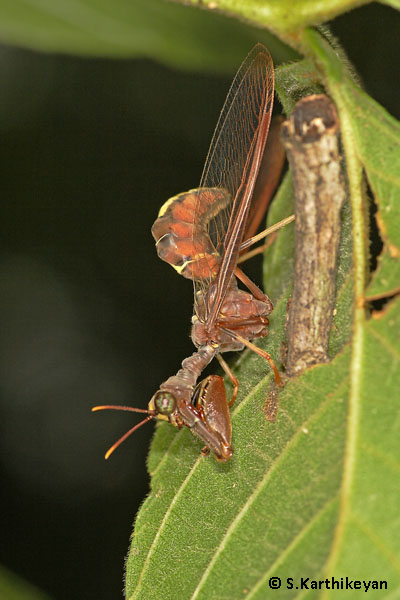
Mantisfly from Dubare

Mantisfly from Dubare

It was in recent times, when I happened to see a mantisfly in my garden, that I was reminded about the above incident and the antics that went in to photographing it. This took me by surprise since I had not seen one in all the years that the garden has existed. I was on the terrace of my house when I saw the mantisfly. It was perched at eye-level on a leaf and not particularly disturbed by the interest that was being showered upon it. It co-operated long enough for me to take my pictures. In fact, it was still there when I had finished shooting and had packed my equipment.
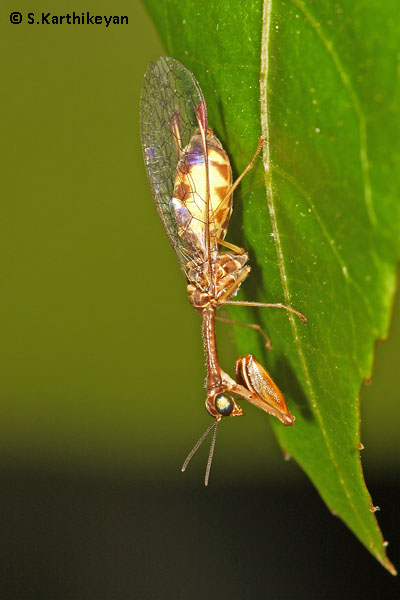
Mantisfly from my garden, Bangalore

Mantisfly from my garden, Bangalore

The second incident renewed my interest in this creature and what I learnt about it was very interesting.

The name mantisfly is a complete misnomer because it is neither a mantis nor a fly! Mantisflies have characters typical of two different insects, primary one being their strong resemblance to praying mantids. Their first pair of legs is very well developed. The triangular head with large eyes also strongly resemble the praying mantids. The other resemblance is their wings which are characteristic of lacewings. In fact, mantisflies are relatives of lacewings, antlions and owlflies (all belonging to order Neuroptera).

As adults, mantisflies feed upon a variety of small insects. They use their well developed first pair of legs to capture prey much like a praying mantis. However, it is the larvae of the mantisfly that has an interesting life style.

The larvae are also predators. They feed on a variety of things that include beetle larvae, flies, bees, etc. However, the habit of the larvae of some species to get on to an unwary spider and wait until she builds an egg case to surreptitiously enter it before it is completed is very interesting. It later makes a meal of the eggs! If the spider that the mantisfly larva is riding happens to be a male, it will wait for the male to get close to a female for mating before moving to the female which would eventually make an egg case!

Very little is known about the 400 or so species of mantisflies in the world. Further research about these creatures would perhaps throw up some very interesting facts about their lifestyles.

  • http://www.connectwithnature.in Kesava

    Wow.. First time for me … nice report and useful information about its life style (larva).

    Thanks for sharing

  • Nahar

    Yet another ‘exposition’ from ‘Man of Small Things’ …

  • Abhishek J

    Very nicely written, thanks for the info!

  • http://Www.avioneye.com Avinash KJ

    Brilliant one here, karthik !
    Loved the post

  • http://www.wildwanderer.com karthik

    Thanks guys. Happy to note that you got to learn something new.
    Best wishes
    Karthik

  • saptha

    Thats very interesting and wonderful information!!!!!!!! thankz karthik

  • http://gravatar.com/deponti Deepa Mohan

    Loved Nahar’s description of you as the “Man of Small Things” :)

    Thanks for the info….will look out for these now, in addition to the zillion other insects that I look at with new eyes after being under your tutelage!

  • http://www.btsquarepeg.com/ Vistasp Mehta

    Very nice! The insect world is such a fascinating one and so full of strange surprises…

    I recall seeing a mantisfly at Bhimashankar around 2005 or thereabouts. It was sitting quietly on the window of our dining room and we all got took turns looking at it and photographing it.

    A lot less risky than climbing 10′ up a tree, wot? :) )

  • http://www.natureclicks.in Saandip Nandagudi

    Wow..Nice find ..lovely photo & facts .. what was the approx size of this mantisfly ..TFS :)

  • JN Prasad

    Wow Karthik nice one to read and great pictures, TFS. Something totally unheard or imagined these exists.

  • Mittal

    Wow! This is wonderful piece of info. Thanks for sharing.

  • http://anushankarn.blogspot.com Anu

    wow! once again an informative post.. something i look forward to, every time i come here!

  • http://www.wildwanderer.com Karthik

    Hello again !

    Thanks to all of you. Am glad that all of you found the post informative and useful.
    Vistasp : Yes the world of insects is truely is amazing and full of surprises.
    Saandip : Both the mantisflies that I have posted photographs of would be about an inch in length.

  • Bineesha

    Fantastic Karthik! Hey I think you should use the title ‘Man of small things!’ and compile all these posts into a book!

    When I saw the first picture of the mantisfly, I was reminded of the Kayan Lahwi tribal women of Burma with their neck rings! Do both male and female mantisflies have long neck?

  • http://www.natureclicks.in Saandip Nandagudi

    Thanks again :) ..

  • Uma

    Brilliant! Never heard of this one till now! Superb pics and write up! Thank you!

  • karthik

    Bineesha … I am told that both males and females have a long neck. However, there could be differences between species.

  • Ashish

    Always a new thing to learn from you Karthik Sir !!

  • http://www.srikanthphotography.com Srikanth

    Lovely Info !! First time I am seeing this !

  • http://backpakker.blogspot.com lakshmi

    A first time for me..interesting how they get their names though