Feed on
Posts
Comments

Waterscorpion

A creature that breathes with its ‘tail’?! Yes, there is one such – the Waterscorpion.

The name is misleading. As it suggests, it is not a scorpion that lives in water; but, an insect, a bug that lives in water! Waterscorpions get their name due to their superficial appearance of some members to scorpions.

Adult waterscorpions breathe with the help of their tail – two filaments sticking to each other that form the siphon. When they stay under water they keep the siphon above so that they can breathe, something akin to a snorkel.

Waterscorpions are essentially bugs. Though they have wings and can fly, they prefer walking at the edge of a water body or amidst aquatic vegetation.The first time I saw one was in a similar setting – well camouflaged, at the edge of the water and submerged. It was just deep enough to ensure that the tip of the tail was out of water. Unfortunately, for a variety of reasons, I could not capture it as it was. I persuaded the bug out of water briefly and got a few quick pictures. Even by the time I got a couple of frames it walked back into the water. This creature looked like a typical bug with a tail.
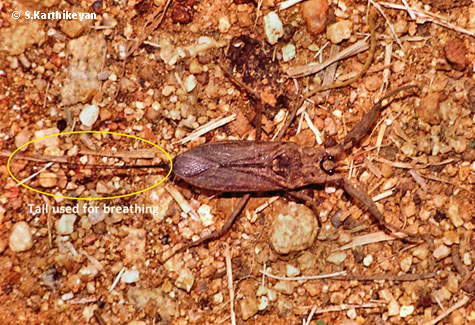
Waterscorpion Nepa sp. having a 'scorpion-like' appearance.

More recently, while on a nature trail at Bannerghatta, I saw yet another which resembled a stick insect. It sat on a stone at the water’s edge; the location posing a challenge for photography.
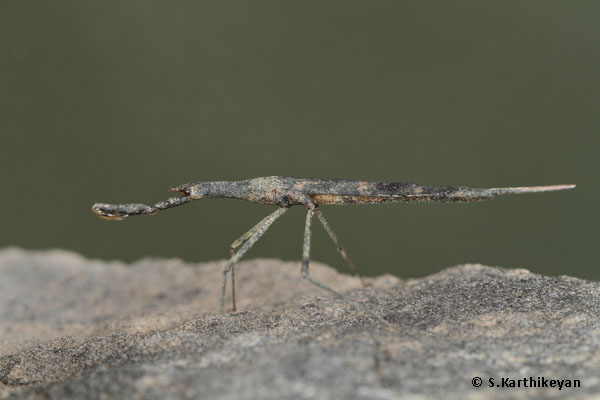
Waterscorpion Ranatra sp. resembling a stick insect.

Waterscorpions use their well developed first pair of legs resembling pincers of a scorpion for grasping prey. Being insects, they have only 3 pairs of legs unlike the scorpions that have 4 pairs. Like all bugs, waterscorpions also have piercing and sucking mouthparts. However, in waterscorpions the mouthpart is short and beak-like.

These are very slow moving insects. However when it comes to catching prey, their movements can be quite fast. Their prey consists of aquatic organisms like small fish, tadpoles, and other insects. After catching the prey they inject it with an enzyme which digests the innards of the prey. The waterscorpion then sucks the contents leaving behind the outer shell of the prey! Waterscorpions are in-turn food to a variety of aquatic organisms like fish.

Having adapted to an aquatic lifestyle, they also breed in water. Adult waterscorpions lay eggs on aquatic vegetation just near the water surface. Eggs are also laid in the mud or decomposing vegetation at times. The young ones are also aquatic and look like miniatures of the adult. They grow as they moult – usually five times before they are adults.

There are over 150 species of waterscorpions in the world. They are better represented over the warmer parts of the world. All of them are placed in a family that is exclusive to these aquatic bugs. In India, we have representatives of both the sub-families of waterscorpions, the above pictures being representative of them.

So, the next time when you are near a water body look out for the usually well camouflaged waterscorpions in the shallow area and also close to aquatic vegetation. For all you know you may get lucky and see one!

  • Arijit Banerjee

    That was fascinating. Thanks.

  • Geetanjali Dhar

    Another well detailed info..Thanks so much for making us aware of one more amazing species .

  • Anjali

    We get to learn so much from you.. Thanks! again, Karthik .. :)

  • http://radha-rangarajan.blogspot.com/ Radha

    Karthik, I remember I once pointed out a Stick Insect and you corrected me that it was in fact a Waterscorpion.. I’ve always looked out for these little fellows by the water since then. Thank you for this informative and detailed post :)

  • http://www.naturecliks.in Saandip Nandagudi

    Superb info ..what an eye level photo sirrr!!! ..TFS :-)

  • Punar

    Yippy ! Saw one in TaalChapper,Churu,Rajasthan. !
    Thanks to you i know the name.
    Can post a frame if you need.

  • chandu

    This fella seems to have cute pair of eyes! Good capture

  • Rohit

    Until now, I never knew that there was a creature called “water scorpion”. Thanks for sharing this information. That second, eye level image is a stunner!!

  • Vinay

    Thanks karthik for educating us on a new species. Will keep a watch out on the next trail.

  • Jayanta Mookherjee

    Thanks for sharing this valuable piece of information. :)

  • http://aranyaparva.wordpress.com/ Rana & Sugandhi

    A tail that forms a siphon-wow, that’s amazing. Every creature has something so unique – thanks for sharing !

  • Deepa Mohan

    I have often seen these creatures but did not get to know much about them until now. Thanks, Karthik

  • Bopanna Pattada

    Thanks for the interesting facts on the water scorpion, been watching these little creatures since I was a boy but never knew about the tail acting as a breathing apparatus.

  • Bineesha

    Thanks Karthik, but for you, I dont think people like us will look into this ‘tiny side’ of the world! Water scorpions are also called needle bugs or water stick insects (Radha..you were almost right!). I read another interesting fact about these amazing creatures…Water scorpions, like most of the other insects, are air breathers. They carry a submerged air bubble for the purpose of breathing under water (I was imagining a scuba diver with his air cylinder). In case of air depletion, they come up to the surface for oxygen.

  • http://www.wildwanderer.com Karthik

    Thanks Bineesha for adding more interesting facts about the waterscorpion.

  • http://backpakker.blogspot.com lakshmi

    Very fascinating..thanks for letting us know

  • Uma

    Wow! What an interesting creature! As always, you add to our gyan! Thank you Guruji!

  • Mukund Joshi

    REALLY RARE PHOTOGRAPHS AND IT ADDED TO OUR KNOWLEDGE. THANKS A LOT

  • Nahar

    Amazingly good !

  • http://zattaya.in/ anuj

    Great…Thanks for the knowledge

  • Niranjan M

    Hi Karthik, seen plenty of these in water used for curing concrete roof when building our home in 1991, was wondering how it got there then. Finally today i learnt the name. Have you any idea how it could have got there?